Product Description
Brand Mettler Toledo
Model UV5
Capacity 190 nm - 1,000 nm
CAT No 30254725
Application Spectroscopy
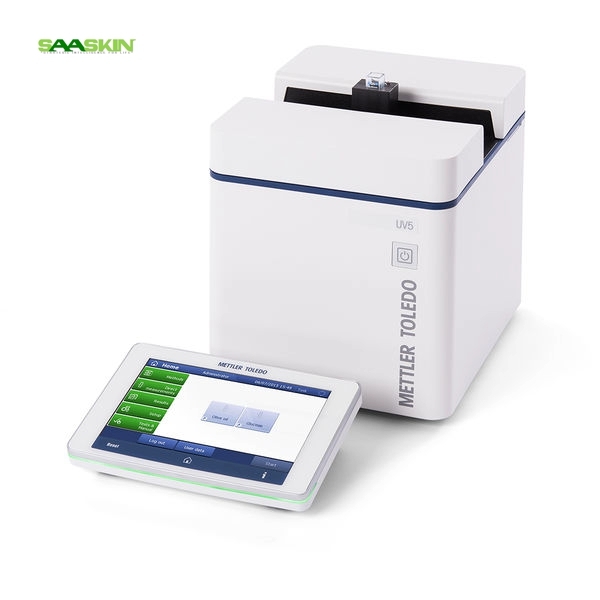
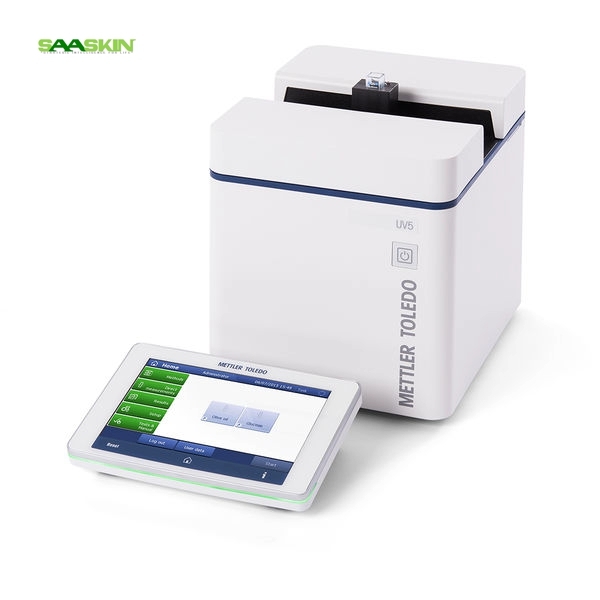
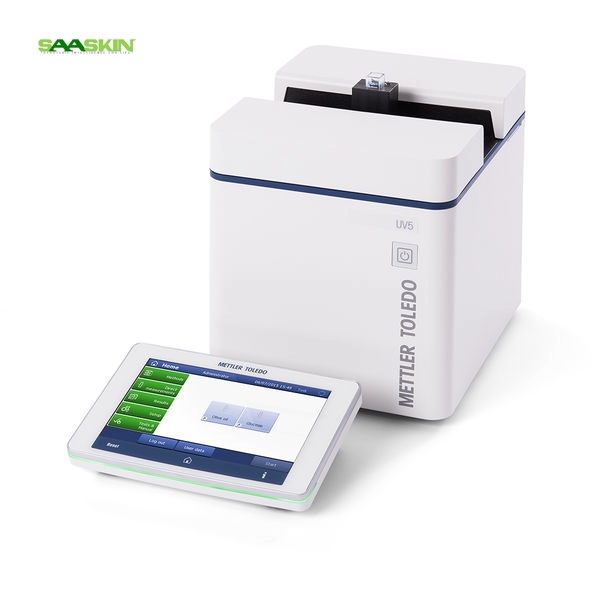
The versatile benchtop UV/Vis spectrophotometer features translucent liquid, solid, and film analysis. Its reliable performance and flexible accessories and software make it the perfect solution for any lab looking to improve efficiency and accuracy
Exceptional Measurement AccuracyThe Mettler Toledo UV5 ensures high-precision results with a wavelength accuracy of 1 nm and photometric accuracy of 0.005 Abs at 1 Abs. Its excellent repeatability makes it an essential tool for critical laboratory analysis in sectors such as research, pharmaceutical, and water quality control. Precise, reliable data supports confident decision-making in every experiment.
Enhanced User ExperienceFeaturing a 7-inch color TFT touchscreen and EasyDirect UV/VIS software, the UV5 offers effortless operation, intuitive navigation, and rapid data acquisition. Built-in data storage and USB/Ethernet connectivity simplify data management and reporting, accommodating various laboratory workflows. No warm-up time is required, allowing users to commence measurements immediately.
Versatile Applications and Compact DesignThe UV5 spectrophotometer is suited for numerous applications-from monitoring water quality to analyzing pharmaceutical formulations. Its compact ABS plastic construction and lightweight design allow flexible placement across laboratory bench spaces. The instrument accepts standard 10 mm cuvettes and requires only 1 ml minimum sample volume, maximizing sample efficiency while minimizing waste.
FAQ's of Mettler Toledo Spectrophotometer UV5:
Q: How does the Mettler Toledo UV5 spectrophotometer improve laboratory workflow efficiency?
A: The UV5 optimizes workflow by eliminating warm-up time due to its xenon flash lamp, enabling users to start measurements immediately. Its touchscreen interface and integrated EasyDirect UV/VIS software streamline operation, data collection, and analysis, significantly accelerating routine testing.
Q: What applications can the UV5 spectrophotometer be used for in a laboratory setting?
A: The UV5 is suitable for a wide range of applications, including water quality analysis, pharmaceutical testing, research experiments, chemical assays, and food & beverage quality assessments. Its versatility supports both quantitative and qualitative measurements.
Q: When should I perform calibration and maintenance on the UV5 spectrophotometer?
A: Regular calibration is recommended as per your laboratory's quality assurance protocols-typically before critical assays or after moving the device. Maintenance is minimal due to advanced optical design; however, routine cleaning of the cuvette holder and periodic software updates are advised for peak performance.
Q: Where can data from the UV5 spectrophotometer be stored and exported?
A: Data can be stored directly on the built-in memory or exported via USB and Ethernet interfaces. This setup allows for flexible data management, backup, and integration into laboratory information management systems for further analysis or record-keeping.
Q: What is the process for analyzing a sample with the UV5 spectrophotometer?
A: To analyze a sample, place at least 1 ml of liquid in a standard 10 mm cuvette, insert it into the holder, set the measurement parameters via the touchscreen, and initiate the assay. Results are displayed instantly and can be stored or exported as needed.
Q: How does the UV5 benefit analytical laboratories compared to traditional models?
A: The UV5 offers improved accuracy, reproducibility, and operational speed, thanks to its precise optical system and no warm-up xenon light source. Its touchscreen interface, compact size, and modern connectivity make it a superior solution for contemporary laboratories seeking efficiency and high-quality results.
Q: What are the environmental and power requirements for operating the UV5 spectrophotometer?
A: The UV5 operates at 100-240 V AC, 50/60 Hz with a power consumption of 40 W. It is designed for laboratory environments with temperature ranges from 10C to 35C, ensuring stable performance across standard lab conditions.












 Accepts only Export inquiries



 Send Inquiry