Product Description
Brand Analytikjena
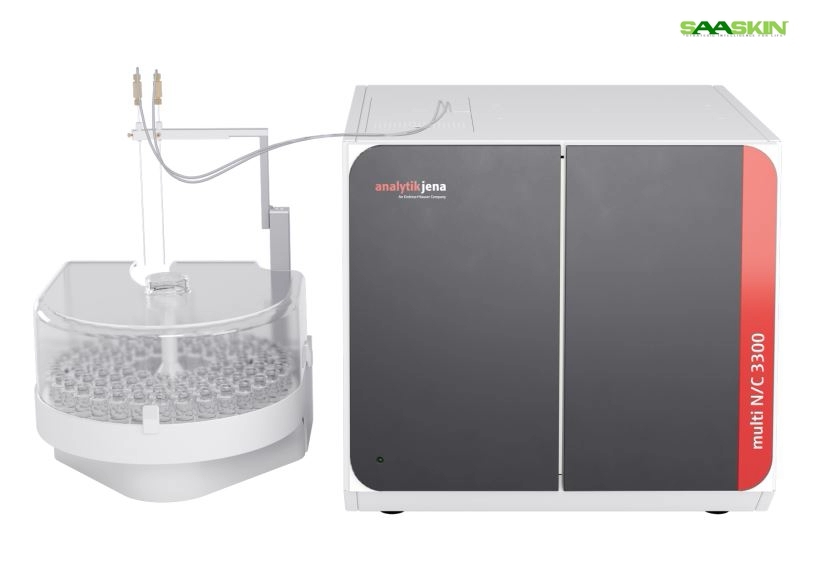
Model 3300 Duo
Capacity 50 - 1000 L
CAT No 450-500.504-2
Application TOC Analyzer
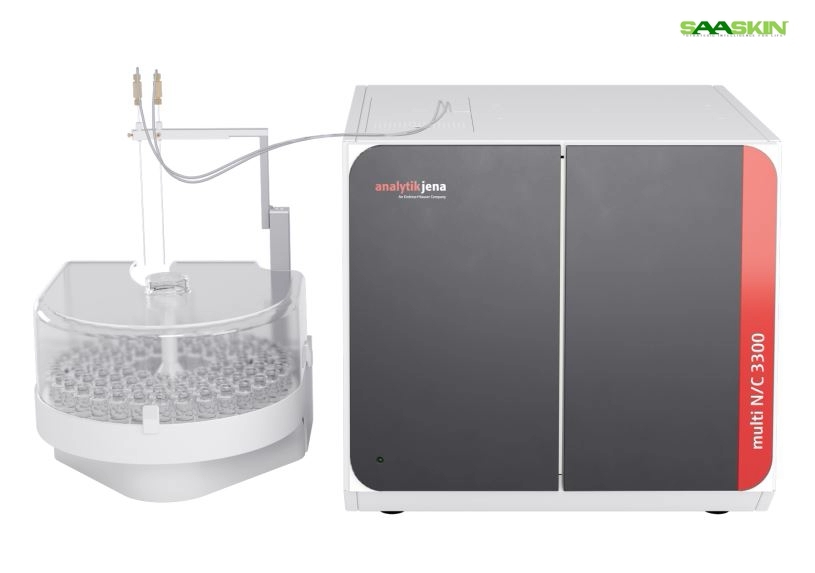
The versatile devices of the multi N/C 3300 series are suited for a wide spectrum of applications such as particle-rich surface water or wastewater, as well as drinking water or ultrapure water. Equipped with special loop injection technology, these devices offer especially high reproducibility for samples containing particles. Thanks to the high injection volumes (1000 - 3000 L), they also offer exceptional sensitivity.
Advanced Sample Processing AutomationWith the ability to process up to 100 samples automatically, the multi N/C 3300 duo excels in high-throughput environments. Its syringe-based autosampler and parallel processing increase laboratory productivity while minimizing manual intervention. Automated maintenance notifications and tool-free servicing further streamline operation, making the instrument ideal for busy laboratories.
Versatile and Accurate DetectionThe device uses a maintenance-free NDIR detector, ensuring precise TOC and TNb analysis across a measurement range from 0.01 to 30,000 mg/L. High-temperature catalytic combustion and an optional UV/persulfate oxidation provide exceptional flexibility for various sample matrices. Its robust build and corrosion-resistant materials ensure long-term reliability in demanding analytical settings.
User-Friendly Software and ComplianceIntuitive software facilitates efficient sample management and is fully LIMS-compatible for seamless data integration. The touchscreen interface, automatic calibration, and comprehensive self-diagnostics reduce user workload. The analyzer meets stringent regulatory requirements, including ISO 8245, EN 1484, and EPA standards, ensuring secured, compliant results.
FAQ's of Analytikjena Multi N/C 3300 duo - Fully Automated TOC Analyzer:
Q: How does the Multi N/C 3300 duo ensure accurate Total Organic Carbon (TOC) and Total Nitrogen (TNb) analysis?
A: The instrument employs both high-temperature catalytic combustion and optional wet chemical UV/persulfate oxidation methods, combined with a precise non-dispersive infrared (NDIR) detector. Automatic multi-point calibration and system self-diagnosis further maintain consistently high accuracy, with repeatability of 3% RSD depending on the application.
Q: What are the key benefits of automated, syringe-based sample introduction in this TOC analyzer?
A: The fully automated, syringe-based sample introduction enhances throughput by handling up to 100 samples with minimal user interaction. This design ensures precise, reproducible injection volumes (up to 8 ml) and allows parallel processing to maximize workflow efficiency while reducing risk of contamination.
Q: When should routine maintenance be performed on this analyzer, and what makes servicing convenient?
A: Routine maintenance is indicated via automated maintenance interval notifications on the touchscreen display. Tool-free user maintenance streamlines servicing, reducing instrument downtime. Features such as a maintenance-free NDIR detector also contribute to lower maintenance demands.
Q: Where can the multi N/C 3300 duo be used, considering its compliance standards?
A: The analyzer is compliant with major international standards, including ISO 8245, EN 1484, DIN 38409, EPA 415.1/9060A, and USP. This makes it suitable for use in research laboratories, quality control, environmental analysis, pharmaceuticals, and industrial settings where adherence to such regulations is necessary.
Q: What process does the analyzer use to handle diverse sample types, including solids and liquids?
A: The multi N/C 3300 duo is designed to analyze both liquid and solid samples (with the duo option), using high-temperature catalytic combustion for robust matrices and optional UV/persulfate oxidation for sensitive or specialized samples. Versatile sample management and variable injection volumes ensure adaptability to diverse testing needs.
Q: How does the device integrate with laboratory information management systems (LIMS)?
A: The integrated software features intuitive sample management and is LIMS-compatible, allowing seamless export and communication of analyzed data through USB, Ethernet, or printer interfaces. This supports secure data handling and efficient workflow integration within laboratory environments.











 Accepts only Export inquiries



 Send Inquiry