Product Description
Brand Eppendorf
Model 5075
Capacity 0.2 AL a 1 mL
CAT No. 5075000045
Application Auto Pippeting
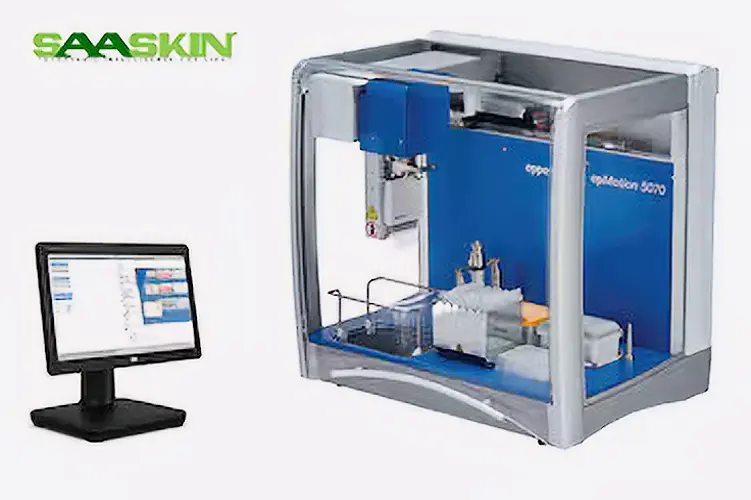
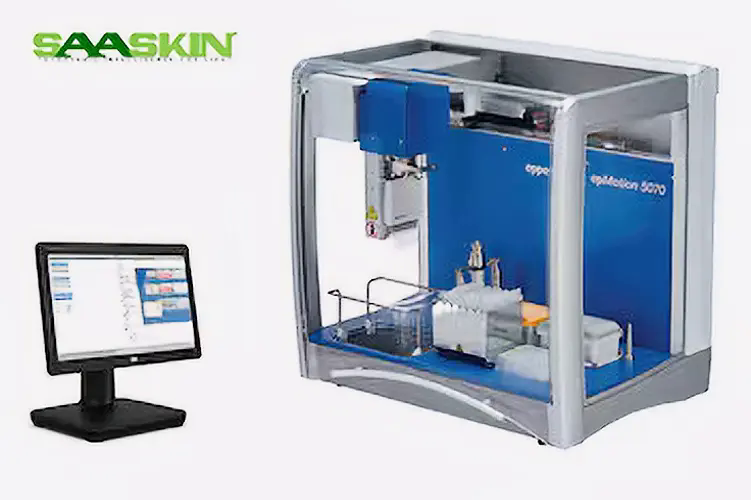
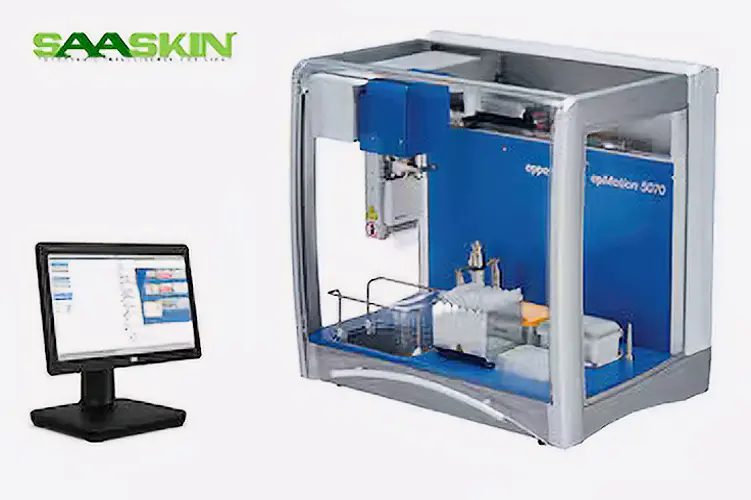
The epMotion 5075t NGS Solution includes all dispensing tools, accessories, and consumables needed for NGS library preparation of up to 96 samples. It automates the process, providing reproducible and precise results while increasing lab productivity. With maximum kit flexibility, it's ideal for medium- to high-throughput and complex NGS workflows, eliminating the need for labor-intensive manual workflows.
Hands-Free Precision for NGS WorkflowsepMotion 5075t reduces manual intervention, automating every stage of NGS library preparation for high sample throughput and reproducibility. The advanced 4-axis robotic arm ensures accurate liquid handling, while active temperature control preserves sample integrity throughout the process.
Streamlined Sample Management and Protocol CreationWith up to 96 samples per run and eight flexible deck positions, the system easily adapts to varying project scales. The user-friendly epBlue software enables rapid protocol creation, modification, and efficient process management, supporting compatibility with NGS kits from multiple providers.
Safety, Connectivity, and Laboratory IntegrationEquipped with UV decontamination, fume extraction readiness, and an optional barcode reader, epMotion 5075t optimizes laboratory safety and traceability. USB and Ethernet interfaces facilitate integration into digital lab environments, and its robust construction supports reliability in diverse Indian lab climates.
FAQ's of Eppendorf epMotion 5075t NGS Solution:
Q: How does the epMotion 5075t improve the efficiency of NGS library preparation?
A: The epMotion 5075t automates pipetting, temperature control, and waste handling, significantly reducing manual tasks. This hands-free operation increases sample throughput, processes up to 96 samples in one run, and ensures consistent, reproducible results, making high-volume NGS workflows seamless.
Q: What pipetting volumes can the epMotion 5075t handle and which tools are used?
A: The system supports a wide pipetting range from 1-1000 L, utilizing specialized automated pipetting tools. This flexibility allows it to accommodate the diverse liquid handling needs of NGS library preparation and related laboratory applications.
Q: When should the integrated temperature module be used during workflows?
A: The integrated termomodule delivers active cooling and heating between +4 C and +70 C, ideal for protocol steps requiring strict temperature control, such as enzymatic reactions or sample storage during multi-step NGS protocols. Use it as specified by your protocol requirements.
Q: Where can the epMotion 5075t be installed, and what operating conditions does it require?
A: The instrument is designed for laboratory environments with ambient temperatures between 15-35 C and relative humidity of 20-80% (non-condensing). Its dimensions fit standard lab benches (1,100 x 800 x 900 mm), and it operates at 100-240 V, 50/60 Hz, making it suitable for most Indian lab settings.
Q: What processes are automated on the epMotion 5075t?
A: epMotion 5075t automates pipetting, temperature control, deck tool changes, barcode-based sample tracking (optional), and waste disposal. The epBlue software orchestrates these steps, ensuring reliable, hands-free execution of complex NGS protocols from sample preparation to cleanup.
Q: How does automated waste handling benefit laboratory workflows?
A: The built-in automated waste disposal system reduces manual intervention, improves safety by minimizing contamination risks, and enhances workflow efficiency by allowing the instrument to handle liquid and tip waste without operator interruption.
Q: What are the main benefits of using the epMotion 5075t in NGS workflows?
A: Key advantages include remarkable precision and reproducibility, substantial time savings due to automation, reduced risk of human error, improved safety with UV decontamination, and compatibility with a wide range of NGS protocols, supporting scalability in demanding research and clinical settings.











 Accepts only Export inquiries



 Send Inquiry