Product Description
| Brand | Thermo Fisher Scientific |
| Product Type | Coprecipitant |
| Pack Size | 300 ?L |
CAT No
| AM9515 |
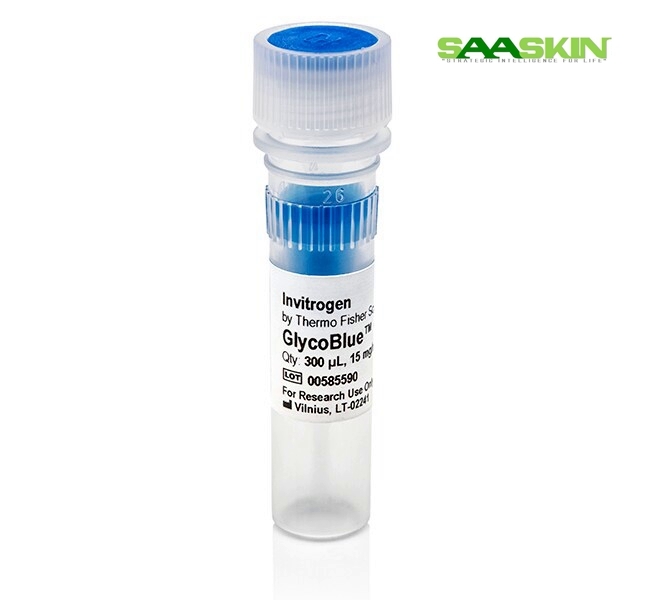
Thermo Fisher Invitrogen GlycoBlue Coprecipitant (15 mg/mL) is a ready-to-use glycogen-based coprecipitant formulated to improve the recovery of low concentrations of DNA and RNA during ethanol or isopropanol precipitation. The blue-colored reagent forms a visible pellet, making nucleic acid recovery easier while minimizing sample loss. It is suitable for molecular biology, genomics, PCR, RT-PCR, qPCR, next-generation sequencing (NGS), cloning, and other nucleic acid purification applications.
Enhanced Nucleic Acid RecoveryGlycoBlue Coprecipitant significantly increases the recovery of small amounts of DNA and RNA, making it invaluable for experiments involving limited or degraded samples. Its vivid blue color enables easy visualization during precipitation, reducing the risk of sample loss and ensuring high-quality results.
Convenient and Reliable SolutionDesigned for automatic and real-time operation, GlycoBlue offers convenience and accuracy in molecular biology protocols. Its portability and compatibility with 2 to 8C storage allow for flexible usage in diverse laboratory environments. This makes it a trusted choice among Indian suppliers, traders, and research institutions.
FAQ's of Thermo Fisher Invitrogen GlycoBlue Coprecipitant (15 mg/mL):
Q: How should Thermo Fisher Invitrogen GlycoBlue Coprecipitant be stored for optimal performance?
A: GlycoBlue Coprecipitant should be stored at temperatures between 2 to 8 degrees Celsius to maintain its effectiveness and ensure reliable results during nucleic acid precipitation.
Q: What is the primary use of GlycoBlue Coprecipitant in laboratory settings?
A: GlycoBlue is mainly used as a coprecipitant to enhance the recovery, visibility, and handling of small DNA and RNA amounts during nucleic acid precipitation protocols.
Q: When is GlycoBlue Coprecipitant most beneficial during nucleic acid purification workflows?
A: GlycoBlue is especially beneficial during procedures involving low-yield or degraded DNA/RNA samples where enhanced recovery and easier pellet visualization are critical to experiment success.
Q: Where can GlycoBlue Coprecipitant be applied in laboratory workflows?
A: GlycoBlue can be employed in a variety of applications such as sample preparation, molecular cloning, sequencing, and real-time PCR, wherever efficient nucleic acid precipitation is necessary.
Q: What is the process for using GlycoBlue Coprecipitant with DNA or RNA samples?
A: To use GlycoBlue, simply add the recommended volume to your sample, mix with a suitable precipitating agent, and incubate. The blue-colored pellet formed after centrifugation makes collection and downstream analysis straightforward.
Q: What are the benefits of using GlycoBlue Coprecipitant compared to non-colored coprecipitants?
A: The primary benefits are improved sample recovery, superior pellet visibility, and enhanced reliability when dealing with low-abundance nucleic acids, leading to more consistent experimental outcomes.











 Accepts only Export inquiries




 Send Inquiry