Product Description
Brand Eppendorf
Model BioBLU
Capacity 0.3f Single Use
CAT No. 1386101100
Application Bioprocess
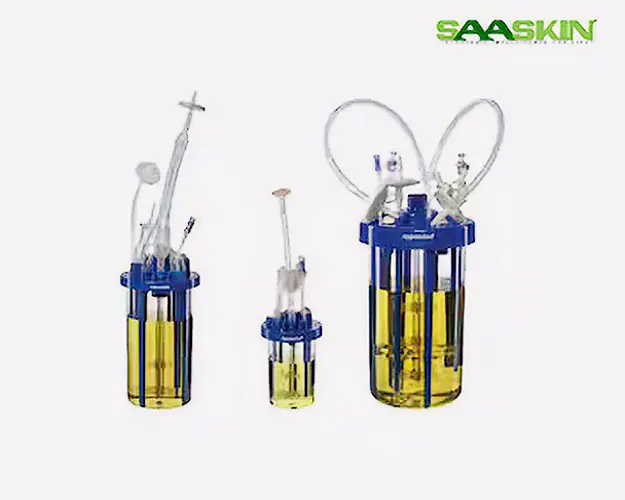
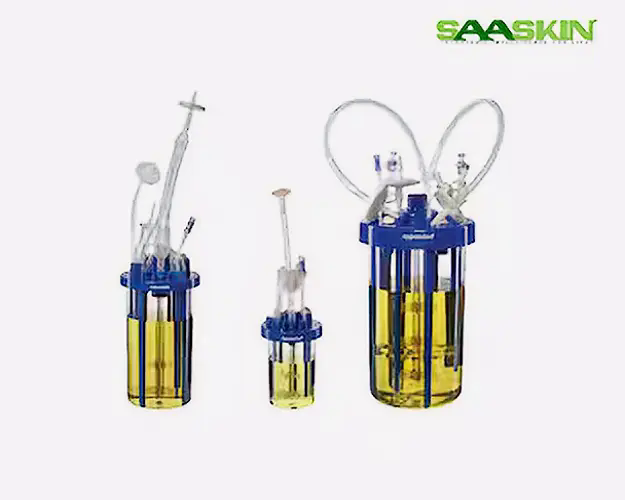
The BioBLU Single-Use Bioreactors for microbial applications at a glance: The rigid wall stirred tank design mimics traditional bioreactors and supports effective mixing and mass transfer making them suitable for high-cell density fermentation.
BioBLU 0.3f (working volume 65??250 mL)
BioBLU 1f (working volume 250?mL??1.25 L)
BioBLU 3f (working volume 1.25?L 3.75 L)
The BioBLU Single-Use Bioreactors are compatible with the small and bench-scale bioprocess controllers from Eppendorf and selected third-party controllers.
Flexible and Ready-to-Use DesignBioBLU 0.3f vessels arrive pre-sterilized and gamma-irradiated, eliminating lengthy prep time and ensuring sterility for sensitive cell cultures. The rigid PETG body and polycarbonate headplate maintain shape and reliability throughout experimental runs. Designed for immediate setup, these bioreactors support efficient workflows and safeguard your research integrity.
Precision Control for Optimal Growth ConditionsIntegrated pH/DO ports accommodate standard sensors, providing accurate monitoring of critical bioprocess parameters. The advanced 3-blade impeller ensures gentle yet effective mixing, while the microsparger enables efficient gas exchange. Combined, these features create optimal conditions for the cultivation of mammalian, insect, or stem cells.
Seamless Integration and VersatilityCompatible with Eppendorf DASbox controllers, BioBLU 0.3f vessels are suited for both batch and perfusion culture. Their small footprint allows for parallel experiments, enhancing throughput for bioprocess development, research, or small-scale production. Flexible connection ports offer easy integration into standard laboratory setups.
FAQ's of Eppendorf BioBLU 0.3f Single-Use Bioreactor:
Q: How do I set up and use the Eppendorf BioBLU 0.3f bioreactor?
A: Simply remove the pre-sterilized, gamma-irradiated bioreactor from its packaging and connect it to an Eppendorf DASbox Mini Bioreactor System or compatible controller. Install standard pH and DO sensors, attach your gas and liquid lines using the Luer-lock and standard tubing connectors, add your culture media, and begin your experiment.
Q: What are the benefits of using a single-use bioreactor like the BioBLU 0.3f?
A: Single-use bioreactors drastically reduce the risk of contamination and eliminate the need for cleaning or autoclaving. The BioBLU 0.3f's ready-to-use format saves setup time, while validated gamma irradiation assures sterility for sensitive cell culture applications.
Q: When is the BioBLU 0.3f bioreactor best utilized in the lab?
A: This vessel is ideal for bioprocess development, research, and small-scale production, particularly when working with mammalian, insect, or stem cells. Its 65-250 mL working volume makes it suitable for early-stage process optimization and parallel experimentation.
Q: Where can I use the BioBLU 0.3f bioreactor?
A: The BioBLU 0.3f is specifically designed for laboratory environments, allowing use in academic, industrial, or pharmaceutical research facilities. Its compact footprint enables parallel operation on benchtop systems.
Q: What processes can the BioBLU 0.3f handle?
A: The vessel supports both batch and perfusion culture processes, thanks to its integrated ports and high-quality mixing and sparging systems. This versatility suits various bioprocessing tasks, including cell culture and biomanufacturing studies.
Q: How does sensor integration work in this bioreactor?
A: The integrated pH and DO ports accept standard optical and electrochemical sensors, enabling precise real-time monitoring and control of essential culture parameters throughout your experiment.
Q: What are the main advantages of the BioBLU 0.3f's construction and materials?
A: Constructed from USP Class VI PETG and polycarbonate, the bioreactor is robust, transparent for visual monitoring, and fully validated for sterility. Its rigid design prevents vessel collapse, supporting reliable mixing, sparging, and long-term culture stability.












 Accepts only Export inquiries



 Send Inquiry