Product Description
Brand Bruker
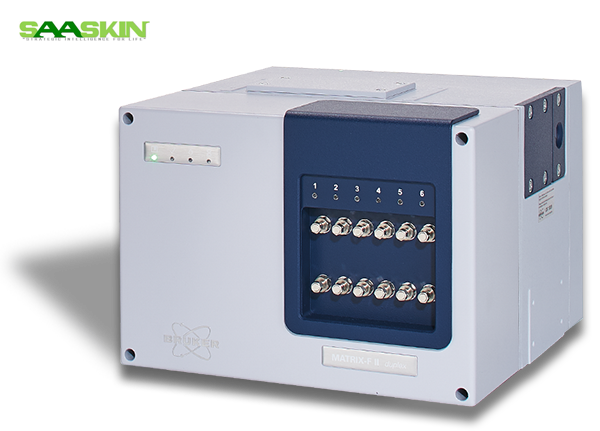
Model MATRIX-F II
Capacity 2G Ex px II T6 Gb
CAT No MATRIX-F II
Application Spectroscopy
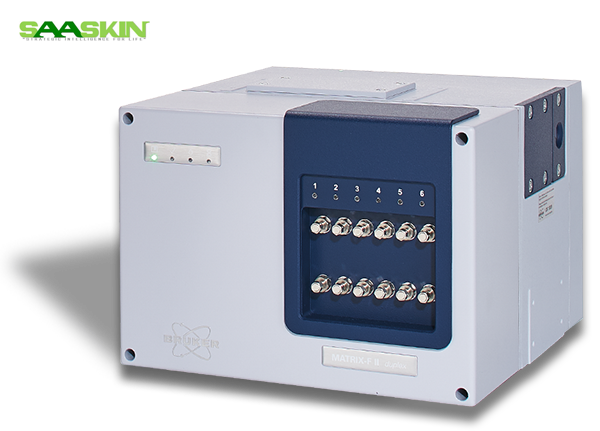
The MATRIX-F II FT-NIR spectrometer allows direct measurements in process reactors and pipelines, leading to a better understanding and control of the process. Its innovative technology provides consistent high quality results, less downtime and direct method transfer. All Bruker process spectrometers are characterized by robustness, long-term stability, and low maintenance costs.
Highly Customizable for Diverse IndustriesThe Matrix F FT-NIR Spectrometer adapts to different industrial environments with its customizable system configuration. Whether you are in food production, pharmaceuticals, chemicals, automotive, or feed manufacturing, the instrument offers flexible measurement points and robust build quality to meet your specific process requirements.
Advanced Non-Destructive AnalysisUtilizing a long-life tungsten halogen lamp and an InGaAs high-sensitivity detector, the Matrix F provides rapid, non-destructive measurements in the NIR region (4000-12000 cm1). This allows for the efficient analysis of samples without altering their integrity, ensuring both rapid quality checks and minimal waste.
Seamless Integration and AutomationEquipped with Ethernet and USB communication interfaces, the Matrix F is designed for easy connectivity and integration into existing process control systems. Automation grades and OPUS software compatibility enable streamlined operation, real-time data processing, and minimal manual intervention, supporting continuous monitoring and fast decision-making.
FAQ's of Bruker Matrix F FT-Near Infrared Spectrometer:
Q: How does the Bruker Matrix F FT-NIR Spectrometer perform in harsh industrial environments?
A: The Matrix F is built to operate reliably in challenging industrial settings. It holds an IP65 protection class, meaning it is highly resistant to dust and water ingress, and is constructed with high-grade metals and industrial plastics, ensuring durability for routine operation in demanding environments.
Q: What processes can benefit from continuous monitoring using the Matrix F?
A: Industries such as food processing, pharmaceuticals, chemicals, and automotive production can leverage the Matrix F for continuous monitoring of raw materials, intermediate products, and final outputs. The system's automation and non-destructive nature allow for uninterrupted quality control and process optimization.
Q: When should calibration be performed on the Matrix F spectrometer?
A: Calibration can be done either at the factory or by the user and should be performed whenever there are significant changes in sample types, application requirements, or after any major system maintenance. Regular calibration ensures sustained accuracy and reliability in measurements.
Q: Where can the multiplexer interface be used within a process line?
A: The multiplexer interface of the Matrix F allows connection to up to 24 measurement positions, which can be distributed at key points along a process line. This setup enables comprehensive monitoring across different stages, from input materials to end products.
Q: What are the benefits of using the OPUS Lab and OPUS Process software with this spectrometer?
A: Using OPUS Lab and OPUS Process software allows for advanced method development, data acquisition, process control, and automation. These platforms enable seamless operation, real-time results, secure data management, and integration with other control systems, maximizing productivity.
Q: How is the Matrix F spectrometer powered and operated?
A: The spectrometer operates on AC mains voltage (100-240 V, 50/60 Hz) and features automatic operation, making it suitable for continuous use. The digital, graphical display facilitates intuitive control and status monitoring by operators.
Q: What types of samples and measurements are suitable for the Matrix F FT-NIR spectrometer?
A: The Matrix F is suitable for a range of sample types-solids, powders, liquids-that are encountered in food, feed, pharma, chemical, and automotive industries. Its non-destructive analysis is ideal for ensuring material quality and process consistency within the 4000-12000 cm1 NIR region.












 Accepts only Export inquiries



 Send Inquiry