Product Description
Brand BioRad
Model Autoblot 3000
Capacity 3000 Strips
CAT No 91600B
Application Immunology
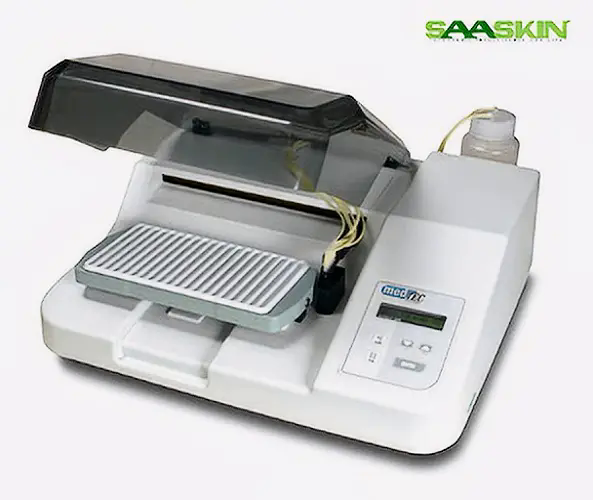
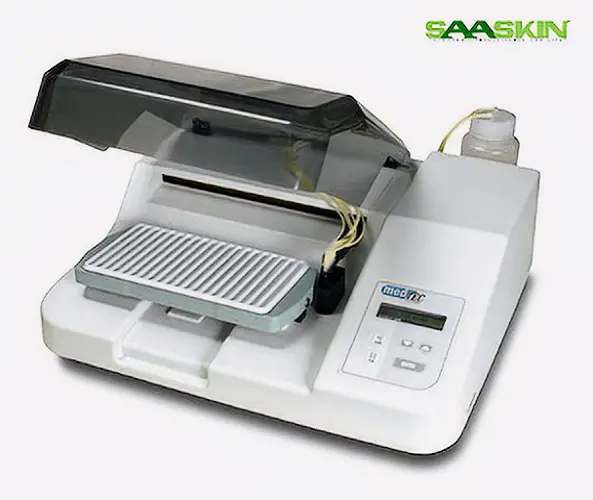
This compact, easy-to-use instrument features pipetting robotics that handle each step of strip assay protocols. Simply dispense patient specimens and select a pre-programmed or custom protocol. All tests steps are automatically performed.
- Eliminates technique-dependent variability
- Easy-to-operate, with true walkaway automation
- Small footprint
- Programmable for use with all Western Blot and strip immunoassay procedures.
Advanced Automation for High ThroughputThe Autoblot 3000 can process up to 20 Western blot strips simultaneously, maximizing productivity and efficiency in busy laboratories. Its five automated reagent channels enable precise reagent handling, reducing human error. Fully microprocessor-controlled, it offers reliable, reproducible results for immunoassays such as HIV, HCV, and HBV.
User-Friendly Design and ProgrammabilityEquipped with programmable incubation, agitation, and temperature settings, the Autoblot 3000 gives users complete control over assay conditions. The built-in rocker platform ensures uniform reagent distribution, while the LED indicators provide clear, real-time status updates. Protocols are easily stored and recalled through its internal microprocessor memory.
Robust Construction and Easy MaintenanceConstructed from powder-coated metal and chemical-resistant plastics, the Autoblot 3000 is engineered for longevity and resistance to harsh laboratory chemicals. The integrated waste collection bottle streamlines disposal, and the instrument's thoughtful design facilitates straightforward cleaning and maintenance. Its low noise level maintains a pleasant lab environment.
FAQ's of BioRad Autoblot 3000 Strip Processor:
Q: How does the BioRad Autoblot 3000 automate Western blot strip processing?
A: The Autoblot 3000 automates the entire Western blot strip workflow by using programmable temperature, incubation, and agitation settings, along with five automated reagent channels that dispense reagents precisely. The built-in rocker platform ensures thorough mixing, and integrated waste collection manages fluids automatically.
Q: What types of assays is the Autoblot 3000 suitable for?
A: This strip processor is designed primarily for immunoassays, including HIV, HCV, HBV, and similar Western blot applications. Its adjustable settings make it compatible with a variety of protocols and assay conditions commonly used in diagnostic laboratories.
Q: When should I use the Autoblot 3000 in my laboratory?
A: The Autoblot 3000 is ideal for laboratories needing consistent, automated processing of up to 20 immunoassay strips per run, especially when high throughput and reproducibility are priorities, such as in routine screening or confirmatory testing environments.
Q: Where is the Autoblot 3000 typically installed and operated?
A: It is designed for benchtop installation in standard laboratory settings and operates under typical laboratory atmospheric conditions (15C-30C). Its compact footprint makes it suitable for clinical, research, and diagnostic labs in India and worldwide.
Q: What is the process of setting up and operating this instrument?
A: Setup involves positioning the instrument, connecting it to mains power (230 V AC), and loading the reagent and waste bottles. Users select or program protocols using the onboard microprocessor system. Once strips and reagents are loaded, the operation is fully automatic until run completion.
Q: How does the Autoblot 3000 benefit laboratory workflows?
A: By automating key steps in Western blotting, the Autoblot 3000 significantly reduces manual labor, minimizes variability, and increases throughput. Its programmable features accommodate diverse assay needs, offering reliable, reproducible results for critical diagnostic work.
Q: What maintenance is required for the Autoblot 3000?
A: Routine maintenance involves cleaning the reagent and waste bottles, checking the chemical-resistant surfaces, and periodically inspecting the rocker platform and liquid handling components. Refurbished models are serviced to meet operational standards and are easy to maintain due to their robust construction.












 Accepts only Export inquiries



 Send Inquiry