Product Description
| Brand | Metrohm |
| Material | Titanium |
| Capacity | 85 mm |
| CAT No | 61204220 |
| Application | Titration Accessories |
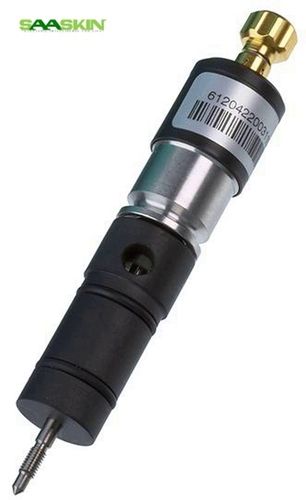
Driving axle for rotating disk electrode (RDE) with titanium axle and mercury contact for VA measuring stands, M3 thread.
High-Precision Rotation for Enhanced ElectrochemistryThe Metrohm RDE driving axle provides smooth, reliable rotation for disk electrodes, essential for reproducible electrochemical analysis. Its mercury slip ring contact is engineered for minimal friction, ensuring stable electrical connection even at high speeds. Designed for compatibility with standard Metrohm electrodes, it meets the demanding requirements of modern laboratories.
Durable and Laboratory-Ready ConstructionConstructed from stainless steel, glass, and high-purity mercury, the axle is built for both mechanical and chemical durability. Easy to mount with a secure screw fitting, it fits seamlessly into most electrochemical workstation setups operating under ambient laboratory conditions.
Safety and Maintenance for LongevitySafety is paramount with mercury-containing components; always follow prescribed protocols during setup, operation, and cleaning. Periodic cleaning of the mercury contact is essential for maintaining signal integrity and device longevity. Detailed user guidelines are provided to support safe and effective operation.
FAQ's of Metrohm Driving axle for rotating disk electrode (RDE) with mercury contact:
Q: How do I install the Metrohm RDE driving axle in my laboratory setup?
A: To install the Metrohm driving axle, securely mount it using the provided screw fitting onto your compatible electrochemical rotating disk system. Ensure that all connections, especially the mercury slip ring contact, are properly aligned. Always operate within ambient laboratory conditions for optimal performance.
Q: What steps are necessary for maintaining the mercury contact?
A: Regularly inspect and clean the mercury contact to preserve low-friction rotation and uninterrupted signal transfer. Use only recommended cleaning agents and follow safety protocols due to the hazardous nature of mercury. Consult the user manual for specific maintenance intervals and procedures.
Q: When should the driving axle be cleaned or serviced?
A: The axle should be cleaned periodically, typically after extended use or if a decrease in signal quality is observed. Adhering to a routine maintenance schedule helps guarantee reliable performance and extends the lifespan of the device.
Q: Where is the optimal environment for using this driving axle?
A: This component is designed for standard ambient laboratory conditions. Avoid exposure to extremes of temperature or humidity, and always operate within a controlled indoor laboratory setting to ensure accuracy and instrument longevity.
Q: What are the key benefits of using a mercury slip ring contact?
A: The primary benefit of the mercury slip ring contact is its ability to provide continuous, low-friction electrical connection during high-speed rotation, reducing signal noise and ensuring high fidelity in electrochemical measurements.
Q: How does the driving axle support precise measurements in electrochemical analysis?
A: By ensuring consistent, smooth rotation and reliable electrical contact, the driving axle enables reproducible experimental conditions, which are critical for accurate data in studies such as reaction kinetics and diffusion studies.











 Accepts only Export inquiries





 Send Inquiry