Product Description
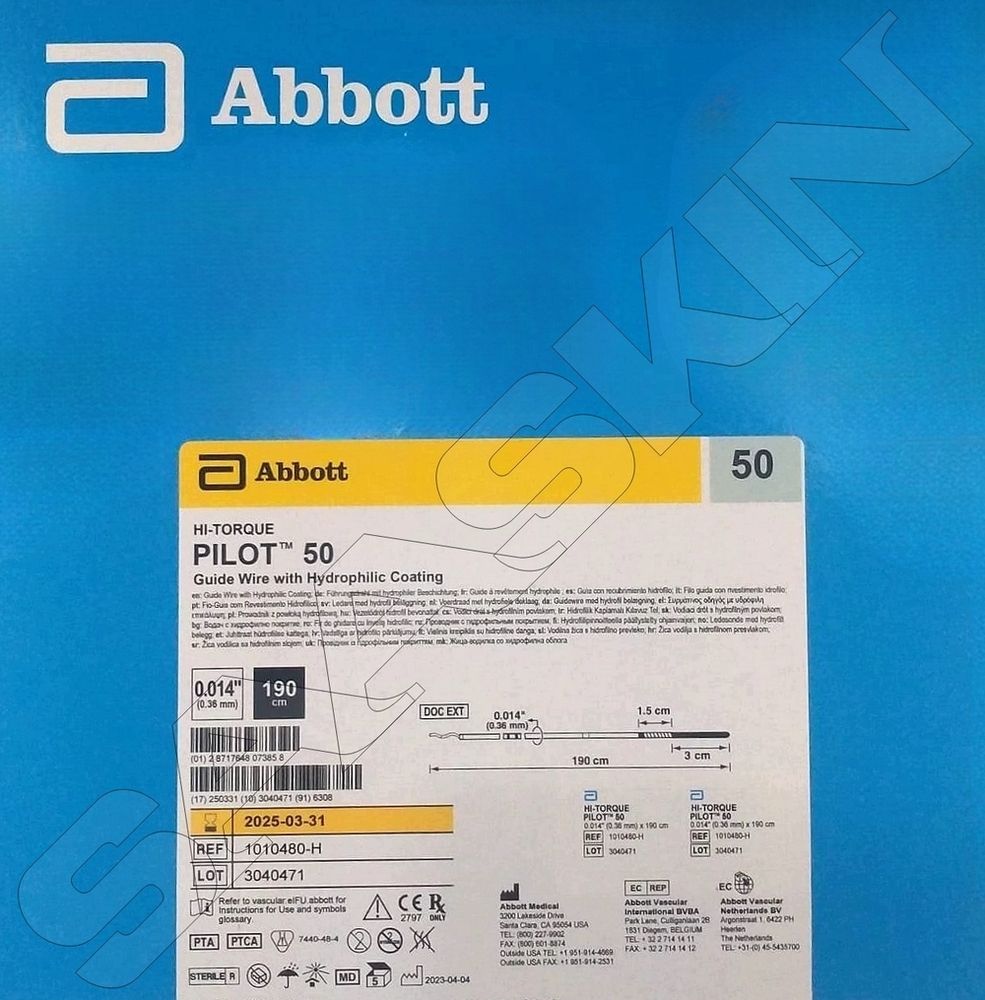
| Brand | Abbott |
| Tip Radiopacity | 3 cm |
| Tip Shape | Straight, J Shaped |
| CAT No | 1010480-H, 1010480-HJ |
| Wire Length | 190 cm |
HI-TORQUE Guide Wires are intended to facilitate the placement of balloon dilatation catheters during percutaneous transluminal coronary angioplasty (PTCA) and percutaneous transluminal angioplasty (PTA).
Optimal Navigation for Complex LesionsEquipped with a hydrophilic polymer coating on the distal segment and a shapeable, soft tip, the HI-TORQUE PILOT 50 Guide Wire provides enhanced trackability and flexibility for navigating highly tortuous and occluded coronary anatomies. Its segmented shaft ensures optimal support, making it ideally suited for challenging PCI cases.
Precision and Visibility You Can Rely OnThe guide wire features a nitinol core for superior kink resistance and high torque control, enabling precise manipulation through challenging vessels. Its radiopaque distal tip offers excellent visual clarity under fluoroscopy, supporting accurate placement and reducing procedural risk during real-time interventions.
Designed for Safety and EfficiencySterilized via Ethylene Oxide (EtO) and individually blister-packed, the HI-TORQUE PILOT 50 Guide Wire ensures single-use safety for every procedure. Its ultra-lightweight, portable construction and compatibility with standard PTCA equipment streamline both preparation and use, supporting efficient workflows in high-demand cathlab environments.
FAQ's of HI-TORQUE PILOT 50 Guide Wires:
Q: How does the hydrophilic polymer coating benefit the HI-TORQUE PILOT 50 Guide Wire during PCI procedures?
A: The hydrophilic polymer coating on the distal segment substantially enhances trackability and reduces friction, enabling smoother navigation through tortuous and occluded coronary vessels. This feature is particularly advantageous for complex lesion crossings.
Q: What makes the tip of the HI-TORQUE PILOT 50 Guide Wire suitable for crossing difficult coronary anatomy?
A: The guide wire is equipped with a soft, shapeable tip that allows precise manipulation and atraumatic advancement through tight or heavily calcified lesions. This design improves safety and efficacy in crossing challenging anatomies.
Q: When should clinicians choose the HI-TORQUE PILOT 50 Guide Wire over standard guide wires?
A: Clinicians should consider the HI-TORQUE PILOT 50 for adult patients undergoing PCI interventions with complex or severely occluded coronary lesions, as its advanced design optimizes navigation and device delivery in such scenarios.
Q: Where can the HI-TORQUE PILOT 50 Guide Wire be integrated within the cathlab workflow?
A: This guide wire is fully compatible with standard PTCA equipment and microcatheters, allowing it to be seamlessly incorporated into routine cathlab procedures without requiring special devices or modifications.
Q: What is the process for using and disposing of the HI-TORQUE PILOT 50 Guide Wire after intervention?
A: The device is designed for single use only. After completion of the procedure, it should be disposed of in accordance with hospital protocols for single-use interventional cardiology devices.
Q: What benefits does the nitinol core provide in terms of performance during coronary interventions?
A: The nitinol (Nickel Titanium) core imparts superior kink resistance and facilitates high torque transmission. This enables reliable, controlled guidance through vessels and minimizes the risk of wire deformation during manipulation.
Q: How should the HI-TORQUE PILOT 50 Guide Wire be stored to maintain its integrity and sterility?
A: To preserve shelf life and sterility, store the guide wire in its original sterile blister pack in a cool, dry place away from direct sunlight. Standard hospital storage protocols should be followed.












 Accepts only Export inquiries



 Send Inquiry