Product Description
Brand Eppendorf
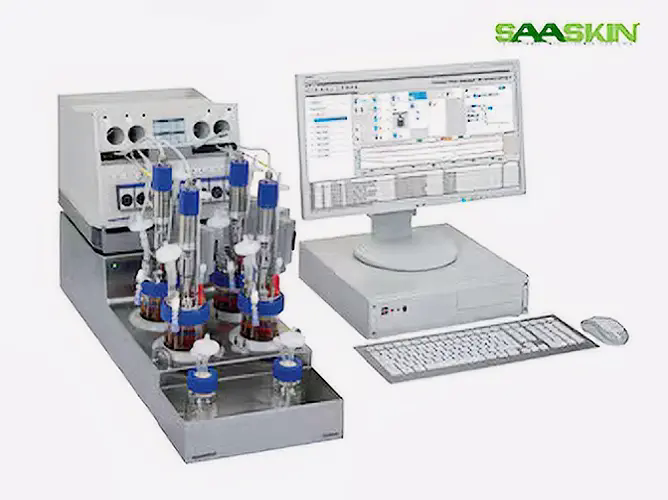
Model DASbox
Capacity 5?sL/h
CAT No. 76DX04CC
Application Auto Pippeting
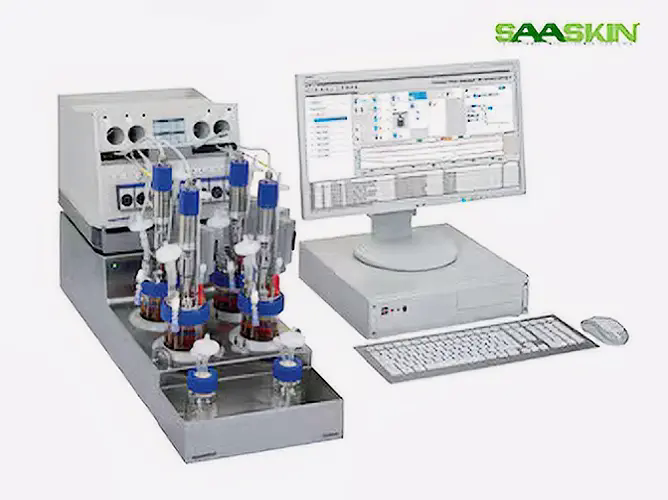
The DASbox Mini Bioreactor System enables highly efficient process development by allowing precise control of critical process parameters, rapid comparison of numerous experimental conditions, reduction of medium costs, and optimal utilization of all generated data.
Small working volumes save resources.
Parallel operation of up to 24 bioreactors saves time and space and improves reproducibility.
Easily convertible from single-use to reusable bioreactors and vice versa.
DASwaresoftware suite enables precise monitoring and control of critical process parameters, as well as the implementation of tailored feedback loops, feeding strategies and other features.
Seamless integration with the Bioprocess Autosampler allows for automated sampling 24/7 to gain complete datasets.
Connects to BioNsightcloud software for remote process monitoring and simple, remote analysis of all data sets to make informed decisions.
Flexible Parallel BioprocessingHandle up to four mini bioreactors independently within a single DASbox system. This configuration allows researchers to conduct parallel experiments, expediting process development and optimization while conserving valuable laboratory space. Each module delivers robust process control, ensuring experimental consistency and efficiency.
Automated, Precise Parameter ControlThe system is equipped with digital sensors and integrated control for pH, DO, temperature, and agitation, all adjustable via the large color touchscreen or DASware software interface. Automated sparge and overlay functions manage the air, O2, CO2, and N2 gases, ensuring optimal culture conditions and reproducibility.
Compliance and Safety EmphasizedThis bioreactor system aligns with GMP and GLP requirements, making it suitable for regulated laboratory environments. Enhanced safety is provided through features such as automatic alarms, emergency stop functions, and user-level security settings. Autoclavable glass vessels and stainless steel construction ensure durability and easy maintenance.
FAQ's of Eppendorf DASbox Mini Bioreactor System:
Q: How does the DASbox Mini Bioreactor System ensure independent control of multiple cultures?
A: The DASbox system allows up to four mini bioreactors to operate independently, with each module having separate automated control over parameters like pH, DO, temperature, and agitation. This individual management guarantees parallel, reproducible experiments tailored to specific process needs.
Q: What are the benefits of using the integrated digital sensors for pH, DO, and optical density?
A: Digital sensors provide precise, real-time measurements and automated feedback control, enhancing accuracy in bioprocess monitoring. This ensures optimal growth conditions, facilitates data acquisition, and improves the consistency and quality of experimental results.
Q: When should I use the DASbox Mini Bioreactor System in my research workflow?
A: This system is most advantageous during process development, optimization, and scale-down modeling, especially when parallel experimentation or high-throughput operations are required. Its scalability and automation streamline workflows from early-stage research through to pre-production trials.
Q: Where can the DASbox system be installed, and what are its space requirements?
A: Designed for laboratory environments, the DASbox has compact dimensions (approx. 307 x 267 x 375 mm per unit) and a moderate weight (around 12 kg), making it suitable for benchtop installation. It fits comfortably in most research labs without occupying excessive space.
Q: What process management capabilities does the DASware control software offer?
A: Eppendorf DASware control software centralizes process management and data acquisition. It allows users to program experimental protocols, monitor real-time data, automate parameter adjustments, and export results for analysis. Compatibility with OPC and SCADA systems facilitates seamless integration into existing workflows.
Q: How is sterility maintained during bioprocessing operations?
A: Sterility is ensured through the use of autoclavable glass bioreactor vessels and stainless steel system components. After use, these can be thoroughly cleaned and autoclaved, helping prevent contamination and maintaining optimal process conditions.











 Accepts only Export inquiries



 Send Inquiry