Product Description
| Brand |
Thermo Fisher Scientific |
| Product Type |
RNA Control |
| Pack Size |
1T |
| CAT No |
4456740 |
| Application |
Molecular Biology |
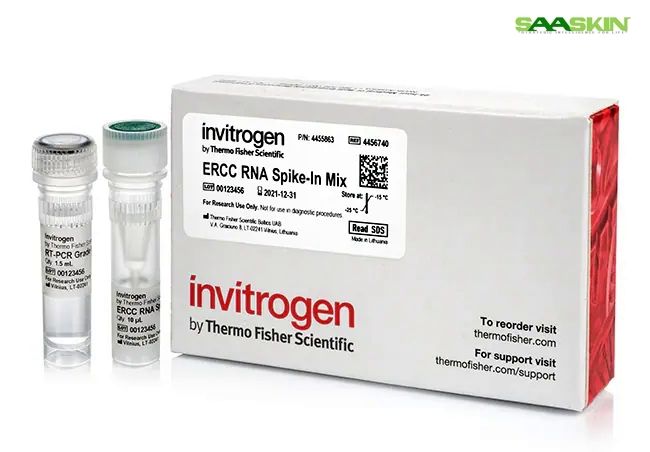
Variation in RNA expression data can be attributed to a variety of factors including the quality of the starting material, the level of cellularity and RNA yield, the platform employed, and the person performing the experiment. To control for these sources of variability, a common set of external RNA controls has been developed by the External RNA Controls Consortium (ERCC), an ad-hoc group of academic, private, and public organizations hosted by the National Institute of Standards and Technology (NIST).
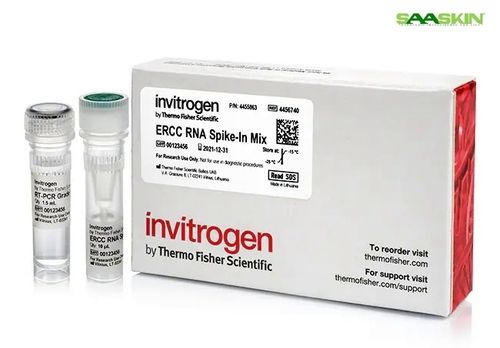
Reliable Normalization for Quantitative Gene ExpressionThe ERCC RNA Spike-In Mix provides an essential external reference standard for accurate normalization in gene expression analysis. Its 92 unique synthetic RNA transcripts mimic natural transcripts, allowing rigorous performance assessment and benchmarking of RT-qPCR, microarrays, and NGS assays. By including this control, researchers can measure experimental consistency and correct for technical variability.
Versatile and Easy to IntegrateSupplied as a ready-to-use liquid mix, the ERCC RNA Spike-In is compatible with a wide spectrum of laboratory workflows. The two concentration options support experimental design flexibility for both high- and low-copy assays. Its colorless solution blends seamlessly into routine protocols, making it ideal for new and experienced users alike.
FAQ's of Thermo Fisher Scientific Invitrogen ERCC RNA Spike-In Mix:
Q: How should the Invitrogen ERCC RNA Spike-In Mix be used in RNA quantification assays?
A: To use the ERCC RNA Spike-In Mix, add the desired volume of spike-in solution directly to your sample prior to RNA extraction or reverse transcription. This allows for precise normalization and assessment of assay performance during RT-qPCR, microarray, or RNA-Seq analysis.
Q: What is the benefit of including ERCC Spike-Ins in my gene expression experiments?
A: Including ERCC Spike-Ins enables normalization of sample input, identification of technical variability, accurate quantification, and improved data reproducibility. Their distinct sequences and defined concentrations help monitor assay sensitivity and linearity.
Q: When should I introduce the ERCC Spike-In Mix during my workflow?
A: The ERCC Spike-In Mix should be added just before RNA extraction or cDNA synthesis. This ensures the controls undergo the same processing steps as your sample RNA, enabling effective normalization and performance evaluation.
Q: Where should the ERCC RNA Spike-In Mix be stored to maintain stability?
A: For optimal stability and shelf life, store the ERCC RNA Spike-In Mix at -80C. Avoid repeated freeze-thaw cycles to preserve RNA integrity and reproducibility.
Q: What is the composition and concentration format of the Spike-In Mix?
A: The mix contains 92 synthetic, polyadenylated RNA transcripts formulated in TE buffer (Tris-EDTA, pH 8.0). It is supplied in two concentration levels (Mix 1 and Mix 2) to allow flexibility for various experimental requirements.
Q: How does the ERCC RNA Spike-In Mix support assay validation and performance benchmarking?
A: Each spike-in transcript acts as an external control with a known sequence and concentration. This facilitates verification of assay sensitivity, dynamic range, and quantification accuracy across platforms, helping to benchmark results reliably.











 Accepts only Export inquiries




 Send Inquiry