Product Description
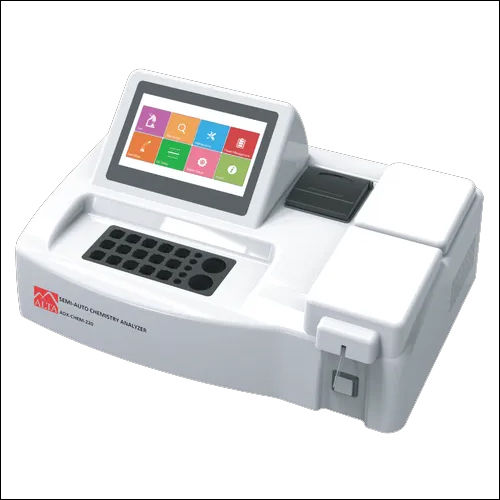
Product details
| Cat No : | ADX-220 |
| Display | 7.0" TFT LCD with touch screen, 800*480 pixels |
| Power requirement | Wide power supply AC100-240V, 50/60Hz |
| Automation | Semi Automatic |
| Dimension | 400 x 300 x 160mm(L x W x H) |
| Brand | ALTA |
High-Efficiency Analytical PerformanceEngineered for rapid processing, this analyser handles up to 200 tests per hour. The robust pipetting system, precise incubation at 37C, and broad wavelength range enable highly accurate chemistry and coagulation analyses. Multiple onboard reagent positions and auto calibration optimize laboratory workflow for maximum throughput.
Advanced Features & Intuitive DesignWith a large LCD display, integrated thermal printer, and Windows-based software, operation and data management are seamless. The auto liquid level detection, alarm systems, and real-time operation make the device both reliable and convenient. Built-in QC programs using Levey-Jennings and Westgard rules ensure ongoing accuracy.
Versatile Connectivity & ApplicationEasily syncing with hospital and laboratory information systems via USB, RS232, Ethernet, and other cable modes, this analyser supports versatile data transmission. It is portable, durable, and made from ABS plastic and stainless steel components, making it ideal for busy lab environments in India.
FAQ's of Fully Automatic Semi-Auto Chemistry and Cogulation Analyser:
Q: How does the analyser handle both chemistry and coagulation tests?
A: This analyser employs photometric, turbidimetric, and coagulation analysis technologies, allowing it to process a wide array of chemistry and coagulation assays. Its flexible onboard reagent positions and precision temperature control support the simultaneous management of multiple parameters, streamlining lab workflows.
Q: What are the benefits of automatic pipetting and liquid level detection?
A: Automatic pipetting with liquid level detection minimizes manual errors, speeds up sample processing, and reduces contamination risks, ensuring consistent, reliable results. This feature is particularly advantageous in high-throughput environments where accuracy and efficiency are paramount.
Q: When should labs use disposable versus reusable cuvettes?
A: Disposable cuvettes are ideal for situations that demand stringent contamination control, such as infectious disease testing, while reusable cuvettes are suitable for routine analyses where cost efficiency and reduced waste are priorities. The analyser's compatibility with both types offers flexibility for various applications.
Q: Where can this analyser be installed or utilized?
A: Designed to fit standard laboratory benchtops with dimensions of 400 x 300 x 160 mm, it's suitable for clinical labs, diagnostic centers, and research facilities. Its portability and user-friendly setup also make it a good choice for satellite labs or field clinics.
Q: What is the process for data management and connectivity?
A: Data can be easily managed and transferred through the analyser's Windows-based embedded software with LIS connectivity. It supports USB, RS232, and Ethernet interfaces, enabling seamless synchronization with hospital and laboratory information systems for efficient data sharing.
Q: How does the built-in QC program enhance laboratory quality assurance?
A: The integrated QC program utilizes Levey-Jennings plots and Westgard rules, enabling real-time quality monitoring and error detection. This ensures that any variability or abnormal results are rapidly identified and addressed, supporting ongoing test accuracy and compliance with laboratory standards.
Q: What advantages does the analyser offer for distributors and suppliers in India?
A: Manufacturers, dealers, distributors, exporters, and suppliers in India will find this analyser an appealing product due to its high throughput, user-friendly interface, and robust data connectivity. Its combination of advanced automation and reliable performance meets the growing demands of modern diagnostic laboratories.











 Accepts only Export inquiries



 Send Inquiry