Product Description
| Brand |
Snibe |
| Sample Type |
Serum |
| Pack Size |
100T |
| CAT No. |
130211003M |
| Application |
Bone Metabolism |
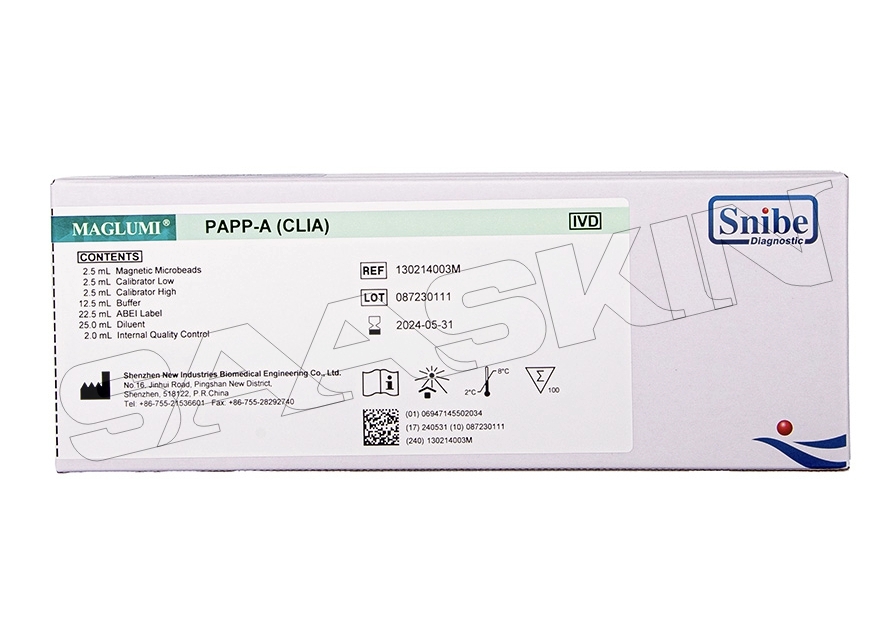
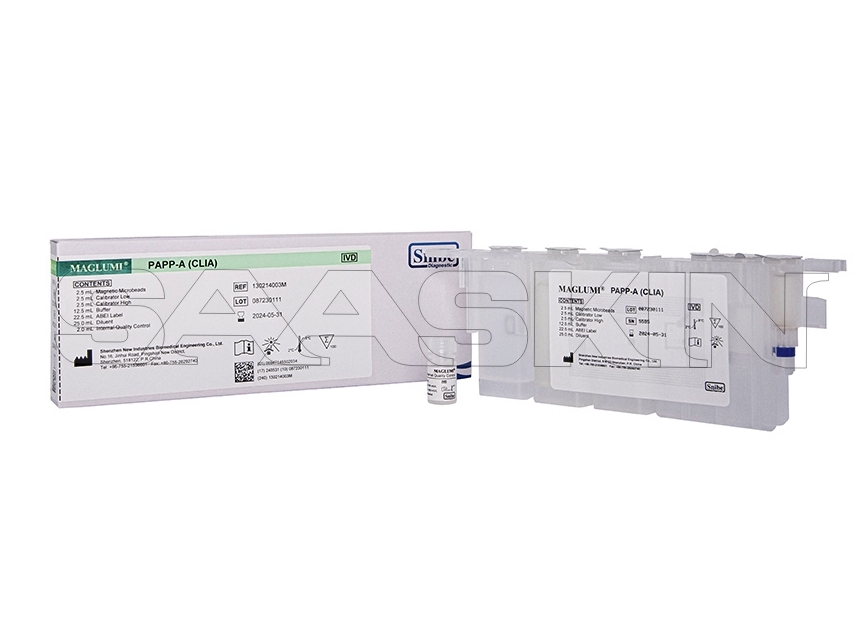
The kit has been designed for the quantitative determination of Pregnancy-associated plasma protein A (PAPP-A) in human serum. The method can be used for samples over the range of 25-10000 mIU/L. The test has to be performed on the Fully-auto chemiluminescence immunoassay (CLIA) analyzer MAGLUMI (Including Maglumi 600,Maglumi 1000,Maglumi 1000 Plus, Maglumi 2000,Maglumi 2000 Plus,Maglumi 3000 and Maglumi 4000).
High Precision Prenatal ScreeningThe Snibe MAGLUMI PAPP-A (CLIA) kit offers clinicians and laboratories a precise and efficient tool for prenatal screening. By delivering quantitative results for PAPP-A in human serum, it plays a crucial role in early pregnancy assessments. The kit's high sensitivity and traceability provide confidence in the screening process, supporting timely and informed clinical decisions for expectant mothers.
Streamlined Workflow with Automated PlatformsDesigned for seamless automation, this reagent kit works directly with Snibe MAGLUMI analyzers. It brings efficiency to routine laboratory operations, reducing manual errors and hands-on time. With ready-to-use components and rapid assay times, laboratories can optimize throughput and maintain reliable results during high-volume testing.
Reliable and Compliant Diagnostic SolutionEach Snibe MAGLUMI PAPP-A (CLIA) kit adheres to strict international standards, featuring lot-specific stability and comprehensive calibration. With a typical shelf life of 12 months and clear storage guidelines, the kit ensures diagnostics remain dependable and accurate for healthcare professionals throughout its use cycle.
FAQ's of Snibe MAGLUMI PAPP-A (CLIA):
Q: How does the Snibe MAGLUMI PAPP-A (CLIA) kit benefit clinical laboratories?
A: This kit streamlines prenatal screening by providing highly sensitive, quantitative measurement of PAPP-A in human serum, utilizing automated Snibe MAGLUMI analyzers. It minimizes manual intervention, delivers rapid results, and aligns with international calibration standards, supporting efficiency and accuracy in clinical workflows.
Q: What types of analyzers are compatible with the MAGLUMI PAPP-A (CLIA) reagent kit?
A: The reagent kit is designed specifically for use with Snibe MAGLUMI series analyzers, including models like MAGLUMI 600, 800, 1000, 2000, 4000, and additional compatible platforms, ensuring broad applicability within clinical laboratories that utilize these systems.
Q: When should the MAGLUMI PAPP-A assay be used during the diagnostic process?
A: It is typically utilized during first-trimester prenatal screening as part of early risk assessment for certain pregnancy-related conditions. The assay provides clinicians with quantitative PAPP-A levels, which are important for evaluating maternal and fetal health.
Q: Where should the kit be stored and how is it maintained?
A: The kit should be stored at 2-8C and protected from light to maintain reagent stability and performance. Each kit comes with lot-specific stability information, and proper storage according to manufacturer instructions preserves the integrity and accuracy of the assay.
Q: What is the process for running a PAPP-A test with this kit?
A: To perform the test, simply load the ready-to-use reagents, calibrators, and controls into a compatible Snibe MAGLUMI automated analyzer. The system then processes human serum samples and provides quantitative results-generally within 30 minutes, depending on the analyzer model and workflow.
Q: Can the MAGLUMI PAPP-A (CLIA) reagent kit be used for real-time diagnostics?
A: Yes, the reagent kit is intended for real-time operation on automated Snibe MAGLUMI analyzers, facilitating prompt and dependable results during routine diagnostics without manual intervention.
Q: What makes the MAGLUMI PAPP-A (CLIA) assay reliable for diagnostic use?
A: The kit incorporates multi-point calibration traceable to international reference standards, uses highly sensitive chemiluminescent immunoassay technology, and undergoes rigorous quality control to ensure accurate and reliable quantitative results for prenatal screening.












 Accepts only Export inquiries



 Send Inquiry