Product Description
Product details
| Fluorometer excitation wavelength | 470 nm, bandwidth: 25 nm |
| Fluorometer light source | LED |
| Light source absorption | Xenon flash lamp |
| Wavelength Range | 200-830 nm |
| Brand | Eppendorf |
| Spectral Bandwidth | 1 nm |
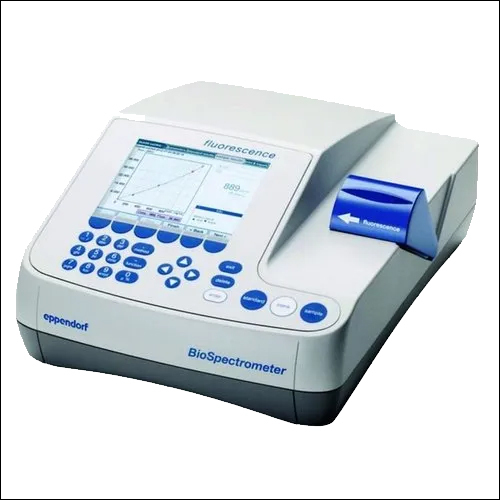
Versatile Measurement CapabilitiesThe Eppendorf Biospectrometer Basic covers a broad spectrum (200-830 nm), allowing sensitive detection of nucleic acids, proteins, and other biomolecules. Its compatibility with several cuvette types, including micro-volume and standard sizes, ensures convenient measurement of various sample volumes, making it ideal for diverse laboratory protocols.
User-Friendly Interface and OperationsEquipped with a high-resolution backlit graphical LCD and pre-installed software, this spectrophotometer simplifies operation and programming. Multilingual support (English, German, French, Italian, Spanish, Russian, Chinese) makes it accessible for a wide range of users, enhancing productivity and reducing training time.
Reliable Data Management and ConnectivityInternal memory stores over 1,000 results and methods, while export options include PDF, Excel (CSV), and XML formats. The instrument supports USB and SD card data transfer, ensuring seamless connectivity to PCs and integration into laboratory data workflows for efficient analysis and reporting.
FAQ's of Eppendorf Biospectrometer Basic:
Q: How do I use the Eppendorf Biospectrometer Basic for micro-volume samples?
A: To measure micro-volume samples, use a compatible micro-cuvette and ensure the sample volume is at least 1.5 L. The instrument's software guides you through sample loading and method selection, and measurements are automatically adjusted for path length.
Q: What types of cuvettes are compatible with this spectrophotometer?
A: The Eppendorf Biospectrometer Basic is compatible with standard cuvettes (10 mm, 5 mm, 2 mm) as well as micro-cuvettes, supporting a variety of sample sizes and experimental requirements.
Q: When should I replace the xenon flash lamp, and how long does it last?
A: The xenon flash lamp has an approximate lifetime of 2,000 hours. Replace the lamp once you notice a decrease in measurement performance or after reaching the end of its rated lifespan to maintain optimal accuracy.
Q: Where can data from the device be saved or exported?
A: Measurement data can be stored in the device's 1 GB internal memory or exported directly via USB and SD card in PDF, Excel (CSV), and XML formats for convenient access and analysis on PCs or other compatible devices.
Q: What operating conditions are required for optimal performance?
A: Operate the instrument in environments with temperatures from 15-35C and up to 80% non-condensing humidity. Placement on a stable desktop surface ensures precise and reliable results.
Q: How does the spectrophotometer benefit hospital and laboratory workflows?
A: With automatic, programmable functions and real-time operation, the Biospectrometer accelerates nucleic acid quantification, photometric, and concentration measurements. Its broad language support and data handling features streamline processes and facilitate data sharing, improving laboratory efficiency.











 Accepts only Export inquiries



 Send Inquiry