Product Description
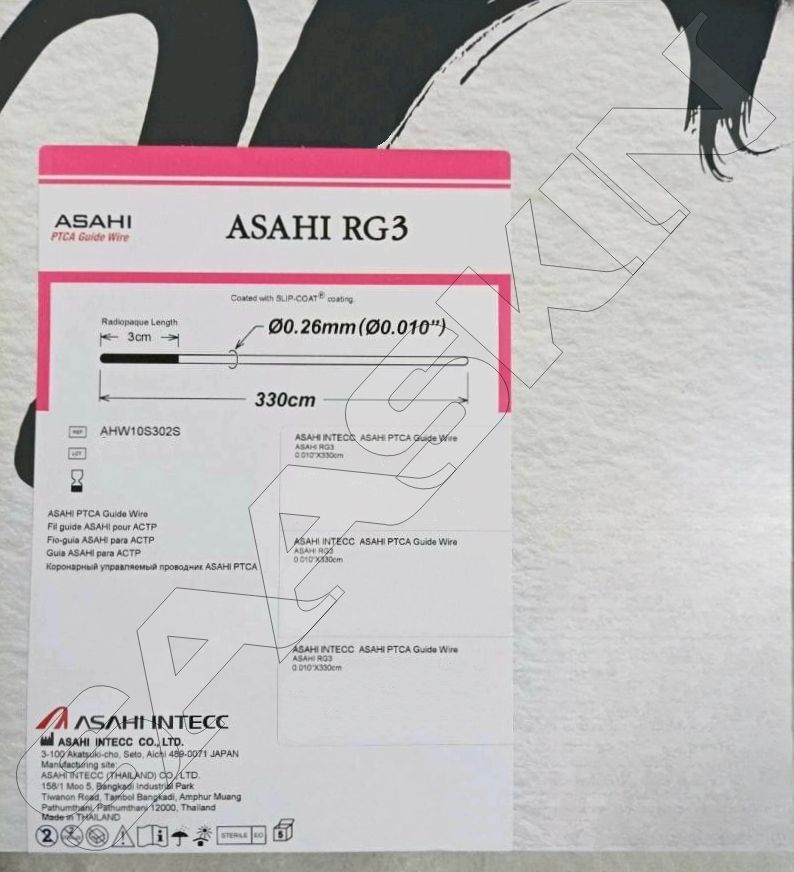
| Brand | Asahi |
| Tip Radiopacity | 3 cm |
| Tip Shape | Straight |
| CAT No | AHW10S302S |
| Catheter Length | 330 CM |
ASAHI PTCA Guide Wires are intended to facilitate the placement of balloon dilation catheters during percutaneous transluminal coronary angioplasty (PTCA) and percutaneous transluminal angioplasty (PTA). The ASAHI PTCA Guide Wires are not to be used in the neurovasculature.
Accurate Flow Measurement for Liquids and GasesThe ASAHI RG3 Rotameter utilizes a variable area principle, providing dependable analog readings for liquid and gas flow rates within the range of 10 to 10,000 LPH. Its engraved or printed scale ensures direct and precise on-site readings, with a standard accuracy of 2% of FSD, making it ideal for both industrial and laboratory applications.
Durable Construction & Versatile ConnectionsBuilt with borosilicate glass and stainless steel or PTFE floats, the rotameter is both corrosion-resistant and long-lasting. The device offers flexible installation with flanged or threaded ends as required, ensuring compatibility with diverse piping systems. Its compact design and low weight enable easy transport and wall mounting.
Reliable and Low-Maintenance OperationWith a mechanical, power-free design, the ASAHI RG3 operates silenty and requires minimal maintenance. It is factory-calibrated for immediate use upon installation. Simply keep the unit in a dry, dust-free environment for optimal longevity, ensuring consistent performance even under harsh industrial conditions.
FAQ's of ASAHI RG3:
Q: How does the ASAHI RG3 Glass Tube Rotameter measure flow rate?
A: The ASAHI RG3 employs the variable area flow measurement principle. As fluid passes through the vertically mounted borosilicate glass tube, the float rises or falls according to the flow rate. The current flow value can be directly read from the scale engraved or printed on the body.
Q: What types of fluids can the rotameter be used with?
A: This rotameter is suitable for both liquids and gases, including water, various chemicals, and process gases. Its stainless steel or PTFE float, along with robust glass and SS construction, allows compatibility with corrosive and non-corrosive substances commonly encountered in industrial and laboratory settings.
Q: Where is the ASAHI RG3 Glass Tube Rotameter typically installed?
A: It is designed for vertical wall mounting and is commonly installed in water treatment plants, chemical processing units, pharmaceutical production lines, laboratory setups, and industrial gas flow systems where reliable flow measurement is essential.
Q: What is the process for installing and calibrating the rotameter?
A: The rotameter arrives factory-calibrated, requiring no additional calibration before use. For installation, connect the instrument to your pipeline using its flanged or threaded ends as appropriate, ensuring it remains vertical. Once mounted and connected, it is ready for real-time flow measurement.
Q: What are the main benefits of using this flow meter?
A: Key benefits include accurate and easy-to-read analog scale, corrosion resistance, reliable operation under varying temperature and pressure (up to 120C and 10 kg/cm2), minimal maintenance, silent operation, low-pressure drop, and versatility for a range of fluids.
Q: When is maintenance required for the ASAHI RG3?
A: Routine maintenance is minimal. Periodically inspect the glass tube and float for deposits or buildup, and ensure connections remain leak-free. Proper storage in a dry, dust-free environment will further extend the instrument's service life.












 Accepts only Export inquiries



 Send Inquiry