Product Description
| Brand |
Snibe |
| Sample Type |
Serum |
| Pack Size |
100T |
| CAT No. |
130209002M |
| Application |
Liver Marker |
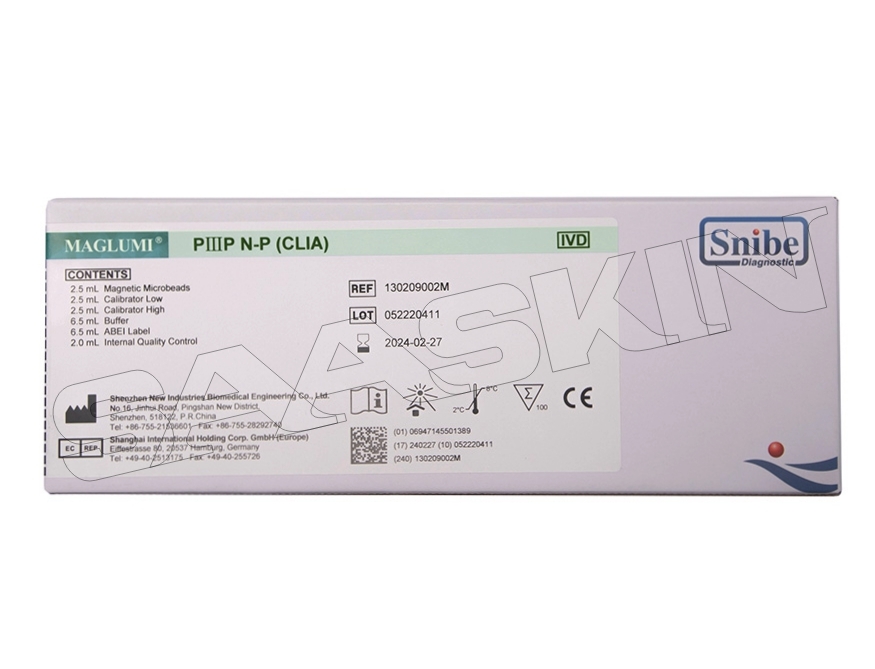
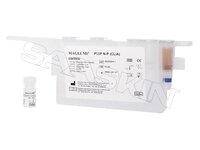
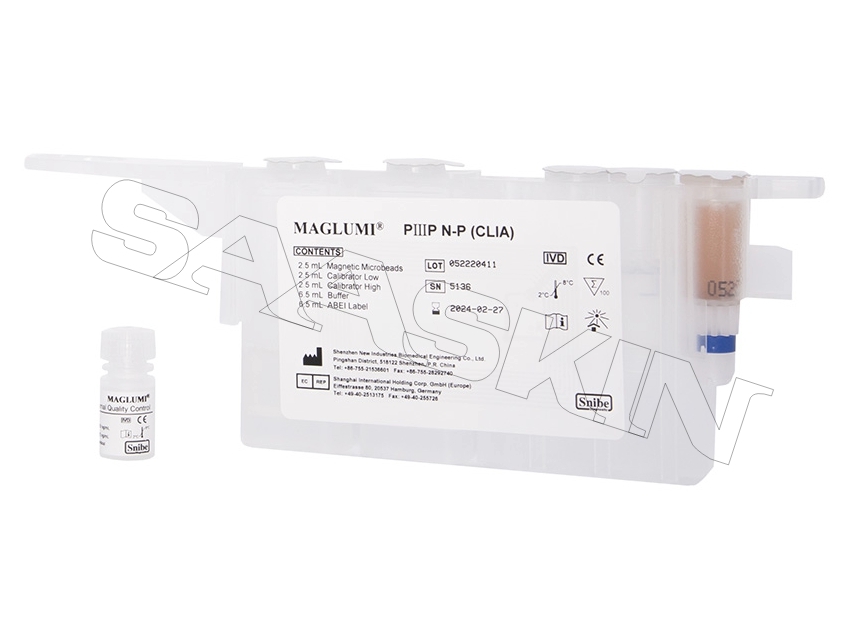
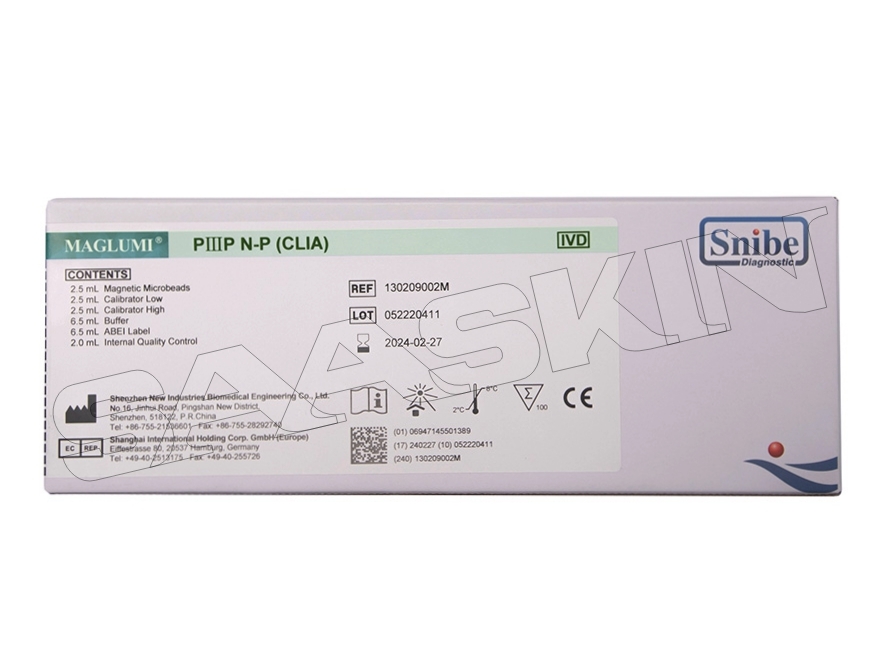
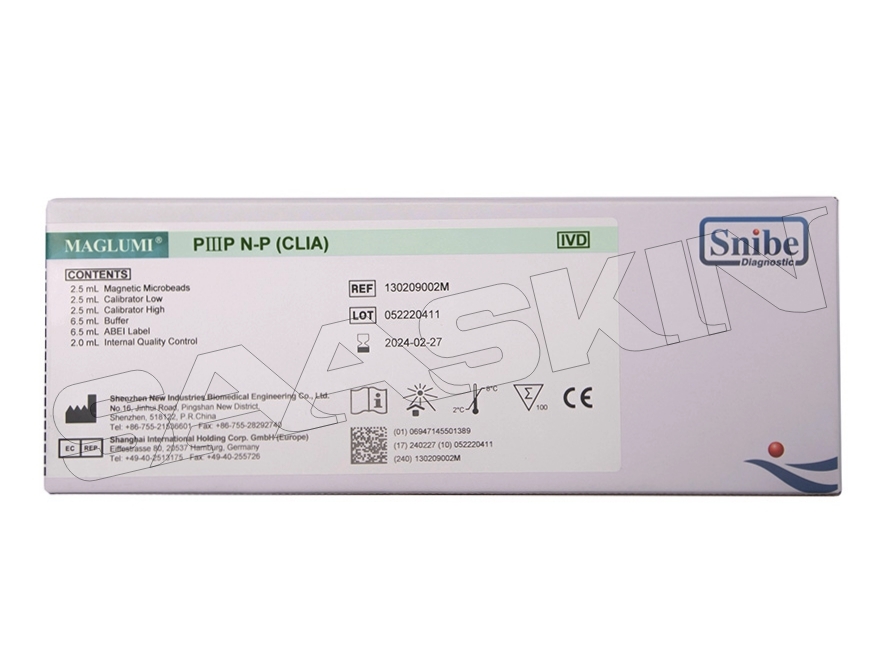
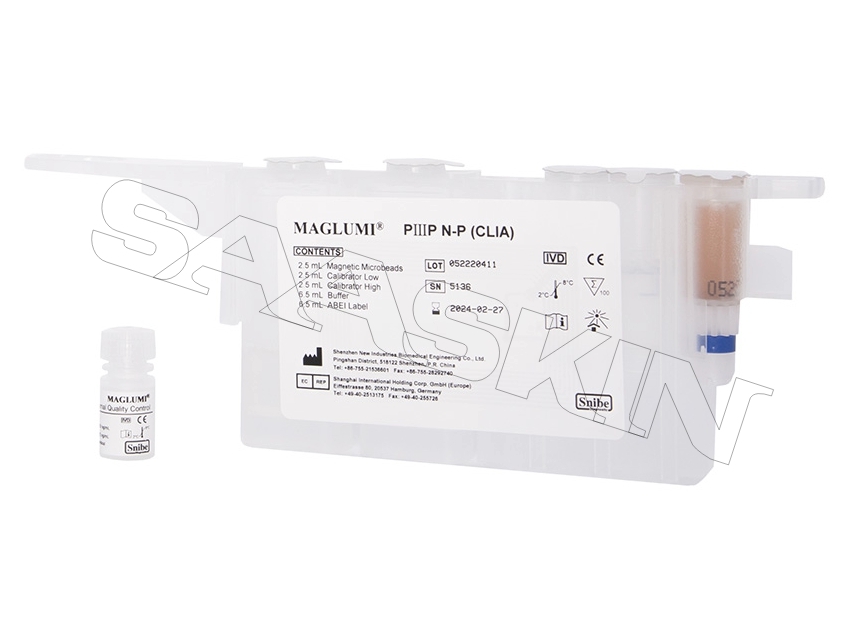
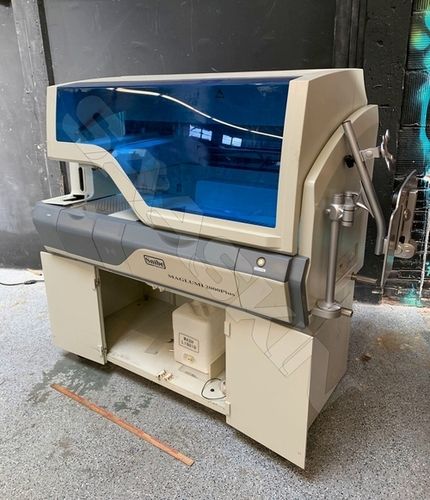
The kit has been designed for the quantitative determination of Collagen Type III N-peptide (PIIIP N-P) in human serum. The method can be used for samples over the range of 5.0-2000ng/ml. The test has to be performed on the Fully-auto chemiluminescence immunoassay (CLIA) analyzer MAGLUMI (Including Maglumi 600,Maglumi 1000,Maglumi 1000 Plus, Maglumi 2000,Maglumi 2000 Plus,Maglumi 3000 and Maglumi 4000).
Advanced Immunoassay TechnologyThe Snibe MAGLUMI PIIIP N-P (CLIA) harnesses precise chemiluminescence immunoassay (CLIA) technology for sensitive and specific measurement of parathyroid hormone levels. This ensures clinicians obtain rapid, reproducible results for confident clinical decision-making.
Seamless Automated OperationFrom sample loading to result output, the system operates fully automatically, minimizing hands-on time for laboratory personnel. Its multi-point automatic calibration and integrated barcode reader streamline the workflow while ensuring high accuracy and throughput.
Superior Usability and ConnectivityWith a digital touchscreen display, multilingual interface, and versatile data output options such as USB, Ethernet, and RS232, the analyzer fits seamlessly into modern laboratory networks. Built-in QC protocols and easy reagent storage guidance help maintain optimal performance.
FAQ's of Snibe MAGLUMI PIIIP N-P (CLIA):
Q: How does the Snibe MAGLUMI PIIIP N-P (CLIA) analyzer ensure accurate parathyroid hormone measurement?
A: The analyzer employs chemiluminescence immunoassay (CLIA) technology, known for its high specificity and sensitivity. It also features automatic multi-point calibration and built-in quality control protocols to guarantee consistent and reliable results with a coefficient of variation (CV) less than 10%.
Q: What sample types and volumes are required for testing with this immunoassay analyzer?
A: The instrument is compatible with both serum and plasma samples. The sample volume needed varies depending on the specific reagent kit and protocol, typically ranging from 10 to 100 L.
Q: When should calibration or quality control be performed on the analyzer?
A: Calibration is automatic and multi-point, triggered according to the manufacturer's protocol or after reagent changes. Quality control is continuously monitored using integrated QC protocols, ensuring ongoing accuracy with every batch of tests.
Q: Where can the Snibe MAGLUMI PIIIP N-P (CLIA) be installed, given its design?
A: This analyzer is designed for clinical laboratories or hospital settings, requiring a stable, non-wall-mounted benchtop installation. It is not portable and should be placed where there is access to electric power (220 V / 50 Hz or 110 V / 60 Hz) and secure reagent storage (2-8C).
Q: What is the benefit of using built-in barcode reading and automated operation?
A: The integrated barcode reader enhances workflow efficiency by quickly identifying samples and reagents, reducing manual entry errors. Automated operation covers all stages from sample introduction to result reporting, streamlining laboratory processes and improving throughput.
Q: How should reagents for the analyzer be stored and what is their typical shelf life?
A: Reagents should be stored at 2-8C as specified by the manufacturer. The typical shelf life is around 12 months, though actual duration depends on the reagent kit. Proper storage is essential for maintaining test accuracy.
Q: What advantages does the analyzer provide for clinical diagnosis of parathyroid hormone levels?
A: The system offers high-throughput quantitative analysis, high accuracy and reliability, fully automated operation, and robust compliance with CE and IVD standards. This makes it highly beneficial for rapid, evidence-based decision-making in laboratory and hospital environments.












 Accepts only Export inquiries



![ZYBIO EXI 25-OH Vitamin D [25(OH)D] (CLIA)](https://cpimg.tistatic.com/13020977/b/4/ZYBIO-EXI-25-OH-Vitamin-D-25-OH-D-CLIA-.png?tr=w300)
 Send Inquiry