Product Description
| Brand |
ESCO |
| Model |
Class III |
| Capacity |
1.2 m2 |
| CAT No |
AC3-4B1 |
| Application |
Biosafety Cabinet |
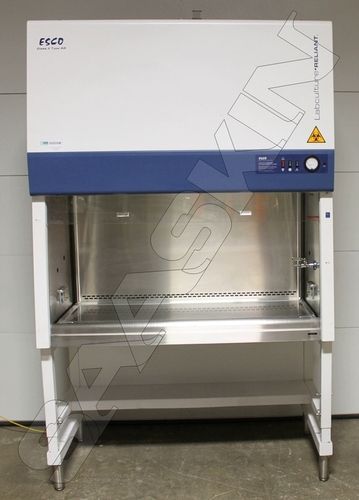
Esco offers a range of Class III Cabinets that provide the highest level of personnel, product and environment protection against agents assigned to biosafety levels 1, 2, 3, and 4. They are often used for handling the deadliest biohazards such as bacteria, viruses, and microorganisms.
Maximum Containment and User ProtectionDesigned for manipulation of highly hazardous biological agents, this Class III Type A2 cabinet maintains total separation between operator and work area. Dual HEPA filters and sealed glove ports prevent any exposure, while automated alarms immediately alert users to changes in airflow or filter integrity, securing both personnel and environment.
Flexible Operation and ErgonomicsOperation is performed entirely via ergonomic glove ports fitted with durable neoprene or Hypalon gloves. The spacious, seamless stainless steel interior provides a contaminant-free workspace for complex laboratory procedures, allowing for peace of mind when handling biohazardous samples.
Reliable Performance and Intelligent ControlA digital microprocessor control system streamlines cabinet monitoring and operation, with clear displays and responsive alarms. The efficient exhaust system and LED lighting ensure safe and comfortable usage, supporting stringent laboratory safety standards in demanding research environments.
FAQ's of Airstream Class III Type A2 Biological Safety Cabinet:
Q: How does the Airstream Class III Type A2 Biological Safety Cabinet ensure operator safety?
A: This cabinet provides maximum protection by completely isolating users from hazardous materials. The fixed, sealed front window and glove ports eliminate direct contact, while dual HEPA filters purify supply and exhaust air. Integrated alarm systems promptly notify operators of any airflow or filter issues, further enhancing safety.
Q: What types of biological applications is this safety cabinet suitable for?
A: It is ideal for high-containment work involving hazardous biological agents, such as in microbiology, virology, and biotechnology research. The cabinet's robust features make it suitable for laboratories handling pathogens requiring stringent safety protocols.
Q: When should the cabinet's HEPA filters be replaced or checked?
A: HEPA filters should be inspected and tested regularly according to your laboratory's maintenance schedule or when the built-in alarm system indicates compromised filter integrity. Exact replacement intervals depend on usage frequency and local regulations.
Q: Where is this cabinet best installed within a laboratory?
A: It is a floor-standing unit intended for installation in biosafety laboratories or containment zones where handling of high-risk agents occurs. Placement should allow enough space for access and accommodate its dimensions (1300 x 800 x 2150 mm).
Q: What process is involved in operating the cabinet?
A: All operations are performed through front glove ports, allowing manipulation of materials inside the airtight workspace. The digital microprocessor control system enables users to adjust settings, monitor airflow, and be alerted instantly to any disruptions or filter issues.
Q: How does the digital control system improve laboratory workflow?
A: The digital microprocessor control provides intuitive operation through clear displays and alarms. It simplifies monitoring, reduces user error, and enables real-time adjustments, ensuring a seamless and user-friendly experience.
Q: What benefits does the dual HEPA filter system offer?
A: With both supply and exhaust air passing through dedicated HEPA filters, the cabinet guarantees consistently clean airflow, preventing cross-contamination and ensuring that hazardous agents are completely contained for optimal user and environmental safety.










 Accepts only Export inquiries




 Send Inquiry