Product Description
| Brand | Roche |
| Model | B 221 |
| Capacity | 9 Parameters |
| CAT No. | 03337111001 |
| Application | Blood Gas Analyzer |
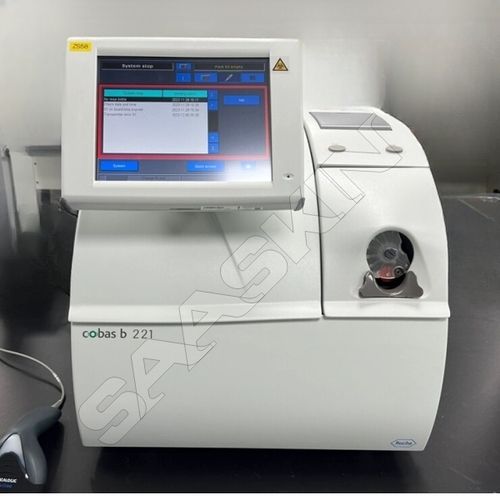
The cobas b 221 system is a fully automated analyzer intended for in vitro testing of samples of whole blood, serum, plasma, acetate and bicarbonate containing dialysis solutions and pleural fluid for the quantitative measurement of: pH, Blood Gas (BG): PO2, PCO2, Electrolyte (ISE): Na+, K+, Cl- , iCa2+, Hematocrit (Hct), Metabolites (MSS): Glucose, Lactate, Urea/BUN (only on cobas b 221 system), Total Hemoglobin (tHb), Oxygen saturation (SO2), Hemoglobin derivative COOX (O2Hb, HHb, COHb, MetHb) and Bilirubin (neonatal).
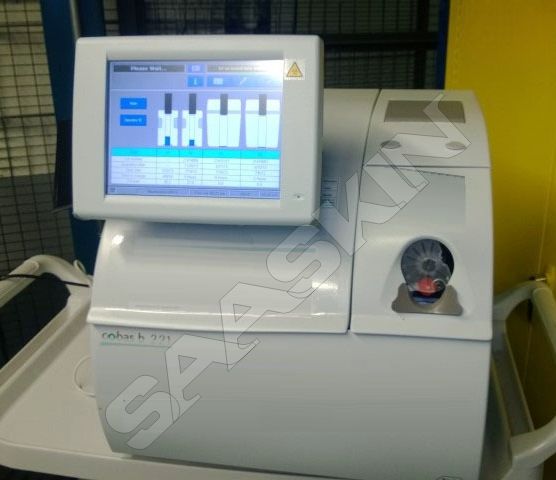
Comprehensive Blood Analysis, Fast ResultsThe Cobas b 221 delivers robust and reliable point-of-care diagnostics. Processing up to 50 samples per hour, it provides real-time analysis of blood gases, electrolytes, and metabolites from a small sample volume. With a swift measuring time of approximately one minute per sample and the ability to store up to 50,000 results, it is well-suited for high-volume medical settings.
User-Friendly Operation and MaintenanceThis analyzer features an intuitive multilingual touchscreen interface, automated calibration, and minimal daily maintenance. User-replaceable cartridges and electrodes reduce system downtime, while easy-access consumables support efficient operation. The integrated barcode reader streamlines sample and operator identification to minimize errors.
Seamless Data Management and ConnectivityEquipped with multiple connectivity options-TCP/IP, RS232, USB, and barcode reader-the Cobas b 221 integrates smoothly with Laboratory Information Systems (LIS), hospital networks, and other lab devices. Its secure internal memory ensures reliable archiving and transfer of up to 50,000 results, supporting audit compliance and streamlined workflow.
FAQ's of Roche Cobas b 221 system:
Q: How does the Roche Cobas b 221 ensure quality control and calibration?
A: The system features automated quality control with integrated barcoding, ensuring consistent accuracy. Calibration is automatic and can also be performed on demand, providing reliable measurement results for every test run.
Q: What types of blood samples and tests can the Cobas b 221 perform?
A: The Cobas b 221 is designed for whole blood samples and is capable of analyzing blood gases (pH, pCO2, pO2), electrolytes (Na+, K+, Ca++, Cl-), and metabolites (Glucose, Lactate, Hematocrit, Hemoglobin) with a sample volume requirement of just 90-150 L.
Q: When and where is the Cobas b 221 best utilized?
A: This analyzer is ideal for point-of-care settings, including hospital emergency departments, ICUs, and laboratory environments in need of rapid and accurate blood test results. It operates effectively within 15C to 30C and can be stored (without reagents) between -20C and +40C.
Q: What are the connectivity features, and how does the system synchronize with other devices?
A: The Cobas b 221 supports TCP/IP, RS232, USB, and barcode reader connectivity, enabling seamless data transfer to LIS/HIS, hospital networks, and other laboratory equipment. Its user interface simplifies network integration and data synchronization.
Q: How does the system handle sample and operator identification?
A: With its integrated barcode scanner, the Cobas b 221 allows both sample and operator identification via barcode, reducing transcription errors and ensuring traceability throughout the analysis process.
Q: What maintenance is involved with the Cobas b 221, and are there any consumables?
A: The analyzer requires minimal daily maintenance. Consumables such as cartridges and electrodes are user-replaceable with easy access, further minimizing downtime and simplifying routine care for busy clinical settings.
Q: What advantages does the Cobas b 221 offer over handheld or manual analyzers?
A: As a bench-top multifunctional analyzer, it delivers high throughput (up to 50 samples/hour), automated processes, and robust data management, which are not typically available in handheld devices. Its advanced technology supports complex workflows, enhancing laboratory efficiency.












 Accepts only Export inquiries



 Send Inquiry