Product Description
| Brand | SD Biosensor |
| Sample Type | Whole Blood |
| Pack Size | 40T |
| CAT No | RK027-40 |
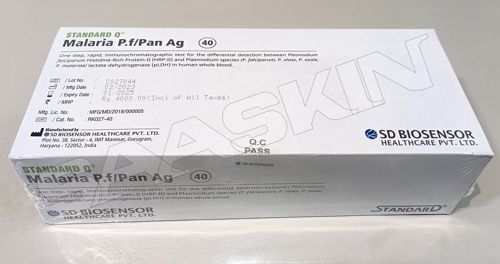
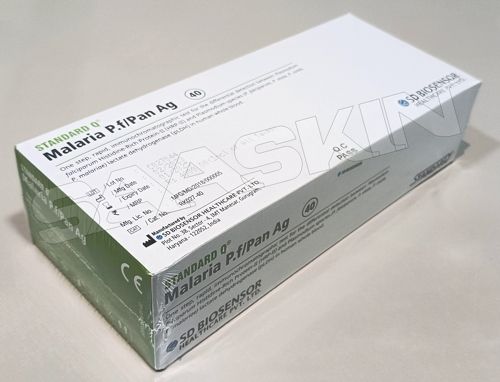
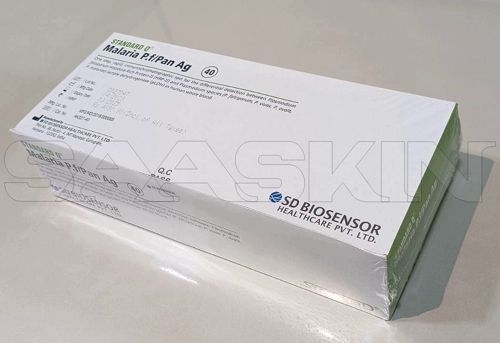
Standard Q Malaria P.f/Pan is an immunochromatographic assay for the differential detection between Plasmodium falciparum Histidine-Rich Protein II (HRP II) and Plasmodium species (Plasmodium falciparum, P. vivax, P. ovale, P.malariae) lactate dehydrogenase (pLDH) in human whole blood. This test is intended for professional use, only for an initial screening and reactive specimen should be confirmed by a supplemental assay such as microscopic examination of thin blood smear.
Efficient Malaria Detection for Diverse SettingsDesigned for both clinical laboratories and field operations, the STANDARD Q Malaria P.F/Pan Ag is a single-use, manual test providing rapid results for malaria antigen. Its compact, portable structure and ability to work without power make it ideal for remote locations. Designed with both sensitivity and specificity in mind, the kit helps professionals detect P. falciparum and other Plasmodium species efficiently.
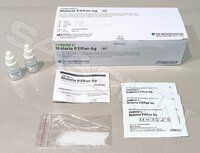
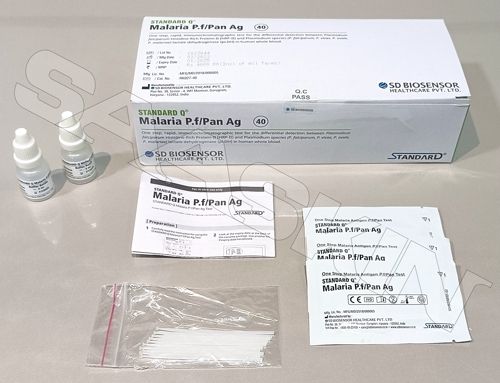
Simple and Rapid ProcedureUsing the SD Biosensor Malaria test is straightforward. Only a small blood sample (5 L) is needed, and results are available in 15 minutes via clear lines on the test strip. No special equipment or power is required, making the process accessible, even in low-resource environments. The kit contains cassettes, droppers, buffer, and clear instructions for hassle-free operation.
Safe, Reliable, and ConvenientThe STANDARD Q Malaria test prioritizes safety and reliability. All kit components are single-use and should be disposed of using biohazard precautions. The device is stable for up to 24 months and must be stored at 2-30C, protected from sunlight and moisture. Visual results reduce the risk of interpretation errors, ensuring confidence in every test run.
FAQ's of SD Biosensor STANDARD Q Malaria P.F/Pan Ag:
Q: How does the SD Biosensor STANDARD Q Malaria P.F/Pan Ag test work?
A: This test works by detecting the presence of Plasmodium falciparum HRP2 antigen and pan-Plasmodium LDH antigen in human whole blood using a lateral flow immunochromatographic assay. When a sample is applied, the antigens bind to specific antibodies on the test strip, producing visible lines that indicate a positive or negative result.
Q: What type and volume of sample is required for the test?
A: The test requires a human whole blood sample, which can be collected from either capillary or venous sources. Only 5 L of blood is needed per test, making the procedure minimally invasive and suitable for field conditions.
Q: When and where can this malaria test be used?
A: The SD Biosensor Malaria test is suitable for use in both clinical laboratories and field settings. Designed for professional use, it is effective in various healthcare environments, including remote or resource-limited areas, since it does not require electricity or additional equipment.
Q: What is the process for using the STANDARD Q Malaria test kit?
A: To use the test, collect 5 L of blood using the provided dropper, apply it to the test cassette, add the buffer solution, and wait 15 minutes. The results are read visually by observing the lines that appear on the test strip, according to the package insert instructions.
Q: What biohazard precautions should be taken during disposal?
A: All used test components, such as cassettes and droppers, should be disposed of following biohazard waste protocols. This precaution helps prevent potential contamination and ensures the safety of healthcare personnel and the environment.
Q: What benefits does this malaria test offer over traditional methods?
A: The STANDARD Q Malaria test delivers rapid results in 15 minutes, requires minimal blood volume, and needs no complex laboratory equipment or electricity. Its high sensitivity, specificity, and portability make it ideal for quick malaria screening in diverse settings, enhancing patient care and timely treatment decisions.
Q: Are there any limitations to using the SD Biosensor Malaria test?
A: Yes, this test is intended strictly for in-vitro diagnostic use and should not be the sole criterion for malaria diagnosis. Confirmatory testing and clinical evaluation may be necessary in some cases as outlined in the instructions for use (IFU).











 Accepts only Export inquiries




 Send Inquiry