Product Description
Brand
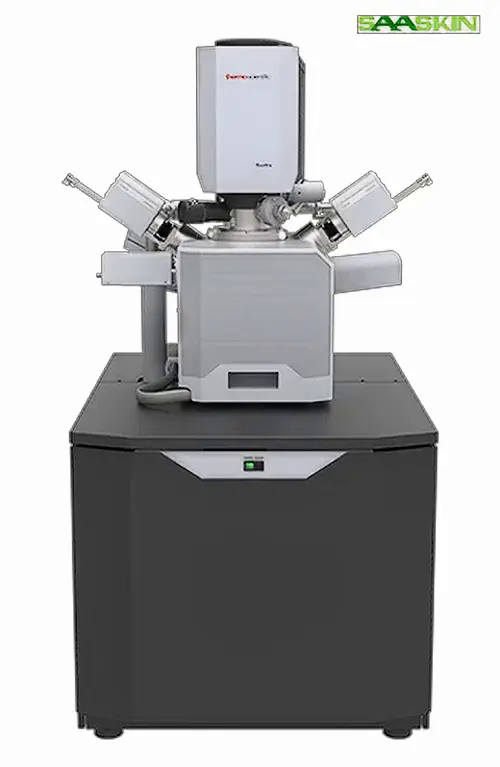
Thermo Fisher Scientific
Model
Prisma
Capacity
110x110 mm 5-axis motorized eucentric stage
CAT No
PRISMAESEM
Application
Microscopy
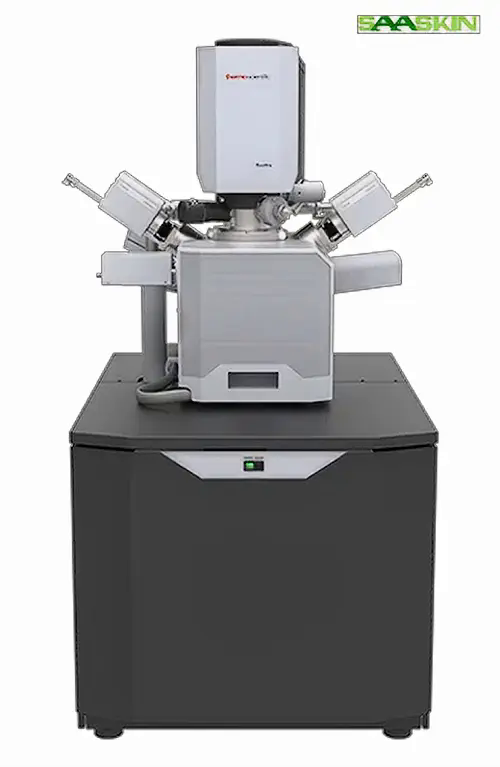
The most complete SEM for multi-user laboratories requiring all-around performance and ease-of-use. The Thermo Scientific Prisma E SEM is the first SEM with unique ColorSEM technology for the most intuitive elemental analysis. Combined with a unique environmental mode (ESEM) and a full range of accessories it is the most complete tungsten SEM available. It is ideal for industrial R&D, quality control, and failure analysis applications that require high resolution, sample flexibility, and an easy-to-use operator interface. Prisma E succeeds the highly successful Thermo Scientific Quanta SEM.
Ultimate Imaging for Materials AnalysisThe Prisma E SEM offers reliable, high-resolution imaging to accurately characterize surfaces and nano-materials. Its advanced vacuum system and detectors provide sharp, detailed results while supporting a range of sample sizes and material types. Whether analyzing failure modes or exploring new material morphologies, this instrument delivers exceptional clarity and functionality for both routine and advanced research tasks.
Intuitive Operation & Flexible ControlWith touch or mouse/keyboard controls, the Prisma E SEM caters to both automated and manual workflows. The intuitive graphical user interface simplifies navigation, analysis, and routine tasks, allowing operators at all levels to benefit from its integrated workflow automation. Automated stage movements (X, Y, Z, tilt, rotate) add precision and flexibility to accommodate diverse research needs.
Enhanced Analytical CapabilitiesThis SEM is compatible with optional accessories such as EDS and EBSD kits, analytical software, and cooling stages. These add-ons further enhance elemental analysis and microscale investigation. Supporting up to five samples (depending on holder), and equipped with compound and secondary electron detection, the instrument is well-suited for comprehensive materials analysis in academic, industrial, or failure analysis laboratories.
FAQ's of Thermo Scientific Prisma E SEM for Materials Science:
Q: How does the Prisma E SEM achieve high-resolution imaging in materials science applications?
A: The Prisma E SEM employs a high-brightness tungsten filament as its electron source and operates at accelerating voltages from 200 V to 30 kV, achieving resolutions up to 2.4 nm. Its advanced detector suite (ETD and CBS), combined with precise electronic controls, allows for detailed imaging of surface topographies and microstructures.
Q: What sample types and sizes can be accommodated in this SEM system?
A: The system can handle samples up to 100 mm in diameter and 40 mm in height. It supports a variety of materials commonly found in nano-material characterization, failure analysis, and surface morphology studies, with chamber capacity for up to five samples depending on the holder used.
Q: When should I consider using the optional EDS/EBSD upgrade kits or analytical accessories?
A: EDS/EBSD kits and other analytical accessories are recommended when your research requires elemental composition analysis, crystalline structure mapping, or advanced failure analysis beyond basic imaging. These upgrades allow in-depth material characterization and are beneficial for both research and industrial quality control.
Q: Where is the Prisma E SEM best implemented for optimal research outcomes?
A: This SEM is ideal for advanced research laboratories, academic institutions, industrial R&D departments, and facilities involved in in-depth materials analysis or failure investigations. Its robust features cater to a wide spectrum of material science applications.
Q: What is the sample analysis process with the Prisma E SEM?
A: The process begins by preparing and mounting up to five samples (sample holder dependent) within the chamber. Samples are then positioned using the motorized 5-axis stage. Operators select imaging modes (secondary or backscattered electron detection) via the intuitive GUI, automate workflows if needed, and analyze or document results using the 19" widescreen display and optional analytical software.
Q: How does intuitive software contribute to efficiency in SEM operations?
A: The built-in software offers a user-friendly GUI that streamlines image acquisition, stage control, and data analysis. Integrated workflow automation accelerates routine processes and enhances reproducibility, minimizing training needs and reducing operator error.
Q: What are the main benefits of using the Prisma E SEM for materials science research?
A: Key benefits include superior imaging resolution, versatile sample handling, advanced analytical expandability (with EDS/EBSD), robust vacuum system for clean imaging, user-friendly controls, and automated/manual operations-making it a powerful, reliable tool for comprehensive materials characterization and research advancement.












 Accepts only Export inquiries



 Send Inquiry